
Cassandra Crossing, The (Blu-ray Review)
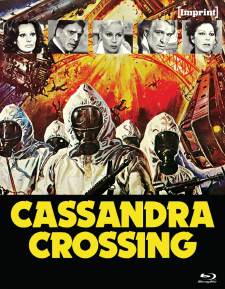
Director
George P. CosmatosRelease Date(s)
1976 (May 27, 2026)Studio(s)
Associated General Films/International Cine Productions/Compagnia Cinematografica Champion/ITC Entertainment (Imprint Films/Via Vision Entertainment)- Film/Program Grade: C+
- Video Grade: A
- Audio Grade: B-
- Extras Grade: B+
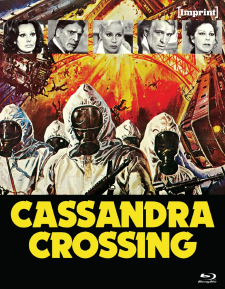

Review
[Editor’s Note: This is a Region-Free Australian Blu-ray import.]
By 1976, the disaster movie heyday was waning. One of the last films in the genre was The Cassandra Crossing, which combined an all-star cast with a story about a potential contagious disease outbreak and the government’s attempt to contain it and prevent mass panic.
Two terrorists break into the World Health Center in Geneva. During a shoot-out, one is killed by marine guards. The other (Lou Castel) smashes into a culture of pneumonic plague bacilli that floods out and enters an open wound. He manages to flee from the facility and stow away on a luxury transcontinental express train bound for Stockholm.
American Col. Stephen Mackenzie (Burt Lancaster) is ordered to the hospital and informs Dr. Elena Stradner (Ingrid Thulin), chief of infectious disease research, that the U.S. government was conducting secret, unauthorized tests to develop a biological weapon and the terrorists were exposed to a highly contagious deadly pneumonic plague virus. The Colonel’s primary concerns are to contain the disease, avoid a panic, and keep the plan secret.
The plot then shifts back and forth between passengers on the train and Col. Mackenzie in his Geneva command post. Dr. Stradner and Mackenzie clash because their priorities are different. Stradner is concerned for the welfare of the thousand people aboard the train while Mackenzie is concerned about maintaining the coverup. He refuses to have the train stopped. His orders are to re-route it to a quarantine facility in Poland. However, that requires the train to cross a ravine via a rickety bridge that may be unable to hold the train’s weight.
Meanwhile, the infected terrorist makes his way through the train, coming in close contact with a number of passengers. These include best-selling author Jennifer Rispoli Chamberlain (Sophia Loren); her former husband, neurosurgeon Jonathan Chamberlain(Richard Harris); Nicole Dressler (Ava Gardner), wealthy wife of an international arms dealer; her boy toy Robby Navarro (Martin Sheen); Holocaust survivor Herman Kaplan (Lee Strasberg); and a mysterious priest, Father Haley (O.J. Simpson).
As in many disaster films, focus shifts from one passenger to another as rudimentary back stories attempt to give them depth. Mostly, however, glaring flaws in the screenplay make it difficult to take the situation seriously. Much in the script is transparently contrived. Placing the divorced Chamberlains on the train is an excuse to hash out reasons for their divorce only to have the crisis they find themselves in draw them together. Robby conveniently has mountain-climbing skills, mostly to center him in a suspenseful sequence. Late in the film, Father Haley’s true purpose on the train comes out of left field. These plot points are contrivances to fill out the film with tangential sub-plots, but needlessly complicate the narrative.
Richard Harris comes off best as a man who can conveniently look after passengers stricken with the disease. Somewhat aloof and condescending in his manner, Dr. Chamberlain transforms from medical expert to hero once the plot turns from drama to action. Harris has a natural delivery and adds some believable acting to a film that’s short on it.
Loren, as beautiful as ever, has a thankless role. Possibly her presence in the cast is due to one of its producers, Carlo Ponti, her husband. Loren adds considerable star power to a mediocre film along with plenty of glamour. Though the camera loves her, she often looks adrift, not certain as to how to react. Maybe she knew she wasn’t dealing with quality material and just couldn’t muster the energy to engage in the story.
Ava Gardner, virtually glowing in her numerous close-ups and mugging shamelessly, suggests she spent more time on conferring with the camera operator than on her performance.
Martin Sheen, one of the younger members of the ensemble cast, postures and preens as the love object of his rich benefactress. Luxuriating in his parasitic role, his character cuddles up to Nicole, looks at her alluringly, and lets her caress him. Sheen portrays Robby as a privileged gigolo, enjoying the benefits of Nicole’s generosity.
Lee Strasberg doesn’t have much to do other than insist he can’t go back to Poland, a country that holds horrible memories for his character. He ambles through the train, as if lost. Perhaps he’s seeking a better part. He makes such a bland impression that when he pops up periodically, his presence reminds us that he’s actually in the cast.
O.J. Simpson, who was very funny in The Naked Gun movies, isn’t very good as a priest who may not be exactly who he seems. His acting is amateurish, his line readings unconvincing, and his big scene laughable. Sometimes when you’re a star on the football field, the same success doesn’t translate to the silver screen.
Director George Pan Cosmatos manages to keep the pace brisk, and things move along reasonably well until the movie becomes a silly mess in its final half hour. Ominous figures in hazmat suits wielding automatic weapons board the train to prevent anyone from getting off. Ordered to shoot anyone trying to leave the train, they patrol the narrow passageways, going from car to car and even welding metal coverings over the windows.
Another major problem with The Cassandra Crossing involves timing. It hit theaters when audiences had already been bombarded with one disaster movie after another. The genre became overly familiar and predictable. Star Wars would premiere the next year, creating widespread fascination with science fiction, helping to bring about the disaster movie’s swan song. At least for a while.
The Cassandra Crossing was shot by director of photography Ennio Guarnieri on 35mm film with Panavision cameras and lenses using the Wescam camera system in which a camera is housed in a spherical swiveling turret that prevents vibrations on a moving vehicle from affecting image stability. The film was originally presented theatrically in the aspect ratio of 1.85:1. The Imprint Films Blu-ray features an aspect ratio of 1.78:1. Clarity and contrast are excellent, with details well delineated. Objects in the train’s lounge car and diner are sharp, as are the helicopter shots of the train moving through the countryside. Both Sophia Loren and Ava Gardner, twelve years older, are photographed to highlight their smooth skin and natural beauty. Miniatures are used for a climactic scene when the train crosses an unsteady bridge. Martin Sheen’s stunt double makes some risky moves clinging onto the train in motion. Col. Mackenzie’s command center is confined to one room, which contrasts with the many cars on the train he’s monitoring. The narrow corridors and staterooms on the train are studio sets. Shadows and lights play on the windows to suggest that the train is moving.
The soundtrack is English 2.0 Mono LPCM. English subtitles are an option. Dialogue is clear even when frequently mixed with the train’s engine noise, outside sounds, clanking of dishes, gunfire, shattered glass, metal giving way under stress, girders collapsing, and train cars crashing into a river. Jerry Goldsmith’s score provides an exciting, driving accompaniment to long-shot images of the train in motion. However, the sound level is uneven, with music recorded much louder than dialogue. This necessitates adjusting the volume frequently. When dialogue and music occur together, it’s hard to understand what characters are saying.
Bonus materials on the Blu-ray release from Imprint Films include the following:
- The Entertainer: The Films of George Pan Cosmatos (19:29)
- Infectious Narratives (13:23)
- Behind-the-Scenes Featurette (7:29)
- English Trailer (2:37)
- French Trailer (2:19)
The Entertainer: The Films of George Pan Cosmatos – Cosmatos enjoyed a 26-year career making crowd-pleasing action pictures. He retired in 1997. He studied at the London Film School and eventually became an assistant director on features, including Otto Preminger’s Exodus. His first two films as director were Sin (1971) and Massacre in Rome (1973). He found his comfort zone directing action films, which led to The Cassandra Crossing. He was able to create many helicopter shots that showed the countryside through which the train was speeding. The film’s budget was $6 million, pretty hefty for the time. The budget enabled him to assemble a cast of stars. Several set pieces in the film “hit their mark.” After The Cassandra Crossing, Cosmatos directed Escape to Athena (1979), in which he referenced several of his previous pictures. Highlights included the use of cross-cutting to show shots of villagers killing Nazis and a mountain-top scene involving a V-2 rocket. Cosmatos considers his only horror film, Of Unknown Origin (1983), his best film. Rambo: First Blood Part II (1985) became a huge summer box office hit.
Infectious Narratives – Doctoral researcher and Pandemic Pages podcast host Lucyl Harrison discusses the mystical touch in The Cassandra Crossing by giving background on the mythical figure Cassandra. The male lead is a doctor, an archetypal figure. The train is a metaphor for unstoppable mechanization. Harrison relates the film to a pandemic point of view. She explains the pneumonic plague, its symptoms, and how it will eventually kill its host. She also discusses the history of plagues in the modern era.
Behind the Scenes Featurette – Made at the time of the film’s original release, this short is of poor quality. A note preceding the short states that it was obtained from the best available source. An off-screen narrator introduces the cast as brief scenes from The Cassandra Crossing are shown along with behind-the-scenes footage and some of the film’s special effects. The narrator refers to the film as “a race with terror” and “a nightmare that never ends.”
The Cassandra Crossing is interesting today mostly for its camp value. Produced and shot as a serious action film that incorporated stories of passengers aboard a doomed train, its flaws seem greater now than when originally released. Seeing O.J. Simpson, for instance, has a chilling effect. And casting the father of method acting, Lee Strasberg, in an underwritten role was a waste. Burt Lancaster, with his clenched jaw and solemn expression, seems to be playing a parody of himself. Beauties Loren and Gardner are nice to look at but add little substance to the film. Richard Harris is fine until he, too, is undermined by a script that becomes silly and strains credibility. The film is a curious relic of its time.
- Dennis Seuling