
Innerspace (4K UHD Review)
Director
Joe DanteRelease Date(s)
1987 (April 28, 2026)Studio(s)
Amblin Entertainment/Warner Bros. (Arrow Video)- Film/Program Grade: B+
- Video Grade: A+
- Audio Grade: A+
- Extras Grade: A

Review
The post-Gremlins career of Joe Dante was a rocky one, moving from one project to the next with little to moderate box office success, despite how creative and appealing his films were to audiences, cult or otherwise. The only instance when the Academy Awards ever acknowledged that his movies even existed came in 1987 with the release of the science fiction comedy Innerspace. It became a small stepping stone for its lead actors who had only received mild exposure up to that point, but the movie’s special effects earned Industrial Light & Magic’s Dennis Muren an Oscar, with Joe Dante left holding the bag after Warner Bros.’ disastrous marketing campaign failed to land the film in theaters. Thankfully, home video was and has been very kind to Innerspace with many considering it to be one of Dante’s best and most accomplished works, despite its relative obscurity, even in the age of streaming, high definition discs, and beyond.
Lt. Tuck Pendleton (Dennis Quaid) is a washed-up military maverick with a chip on his shoulder and a glass of whiskey in his hand, much to the chagrin of his girlfriend, ace reporter Lydia Maxwell (Meg Ryan). She reluctantly splits up with him after an embarrassing drunken blowup in public, whereupon Tuck sobers up and get involved with a secret scientific experiment, agreeing to pilot a submersible capsule in miniaturized form into the body of a lab rabbit. During the experiment, he winds up in a syringe and the lab is taken over by a group of rivals, led by Dr. Margaret Canke (Fiona Lewis) and Victor Scrimshaw (Kevin McCarthy), who intend on stealing the miniaturization technology. The experiment’s lead scientist, Dr. Ozzie Wexler (John Hora), escapes with the syringe, and in an act of desperation to save Tuck from the clutches of the evil henchman Mr. Igoe (Vernon Wells), he injects him into the butt of a stranger, hypochondriac grocery store clerk Jack Putter (Martin Short). Tuck is confused about what body he’s in at first, but eventually makes contact with an initially skeptical Jack, putting his life into complete disarray as he instructs him to find Lydia and evade Mr. Igoe and the other scientists, as well as another newly-arrived henchman, “The Cowboy” (Robert Picardo). The rest of the cast includes Wendy Schaal, Henry Gibson, William Schallert, Mark L. Taylor, Harold Sylvester, Orson Bean, Kathleen Freeman, and as always in every Joe Dante production, good ole Dick Miller.
Various directors in Hollywood like Robert Zemeckis, Steven Spielberg, and even John Carpenter were offered Innerspace at various points, the latter of whom nearly took on the project. Jeffrey Boam’s re-write of Chip Proser’s script, which was basically a take-off on Fantastic Voyage, eventually grabbed Joe Dante who liked the idea pitched to him that “what would happen if we shrank Dean Martin down and injected him inside Jerry Lewis?” It proved to be a match made in heaven, even if there were issues during production. Warner Bros. initially wanted somebody other than Martin Short, perceiving him to be not handsome enough, and also demanding the budget be trimmed for the special effects. Producer Michael Finnell gave in to the latter demand, though when the film was nearing completion, they realized that they needed that money to complete the film anyway. At the time, Martin Short and Meg Ryan had done very few films and were mostly known for their TV work, and Dennis Quaid, the most well-known of the three, had just appeared in Jaws 3-D, The Right Stuff, Dreamscape, and Enemy Mine. Interestingly, he and Meg Ryan wouldn’t become a couple until the following year, in the remake of D.O.A.
Despite Martin Short and Dennis Quaid never appearing in the same frame until the very end, they have terrific chemistry, with Quaid purportedly off-set during Short’s takes to act with him. There’s also a lovely non-love triangle between them and Meg Ryan’s characters, which is actually kind of sweet, especially during the conclusion when she picks one over the other, but still appears to have feelings for the one she doesn’t choose. Martin Short’s brand of comedy also helps sell the concept, taking an everyman and putting him in extraordinary circumstances, coming out of it a different and more well-rounded person, ready to take on the next challenge. However, the biggest star of Innerspace is arguably the visual effects, which hold up beautifully almost forty years later. The interiors of Jack Putter’s and Lydia Maxwell’s bodies aren’t exactly realistic, but they’re organic enough that you buy it, helping to sell the premise. Only one of the special effects, which is a close shot of Tuck inside the capsule, doesn’t look very good, but the rest of the effects still work wonderfully.
The other part of the equation is the sensibilities of Joe Dante. It has his weird eccentric DNA written all over it, from the random nuns and costumed characters during the chase in the mall to Looney Tunes references to the casting of John Hora (his usual director of photography) to Dick Miller to The Cowboy (an entire book could be written about his character). His sensing that the film needed to be more of a comedy with a ticking clock element and outside forces conspiring to bring harm to our lovable trio of characters works perfectly. In fact, one of the scenes that was trimmed during the initial budget cuts was the scene in which Jack and Tuck actually bond while Jack is in Tuck’s apartment. It’s a lovely scene and it makes you care about the outcome of these characters, and the film would have been the lesser without it. Realizing that they needed it, they were given back the budget to shoot it, along with other scenes.
The filmmakers were always concerned with the title and no one really knew what to call it, but nobody could come up with anything better than Innerspace. Sadly, it wasn’t a hit upon release, though it did receive some good critical notice. It opened against Adventures in Babysitting, which definitely took more of a bite at the box office that weekend, but the ad campaign for Innerspace, featuring a tiny figure in between a giant finger and thumb, did nothing to help it. Nor did the subsequent re-campaign, featuring an absolutely horrible rendition of Martin Short with his mouth wide open and the miniaturized pod flying out of it. When the film came to cable and VHS, it gained a much larger audience, but over time, Joe Dante’s other films such as Gremlins and The Howling received much more cult-friendly notice, and Innerspace got lost in the shuffle. That tide appears to be turning once again and newer audiences are discovering that Innerspace is a quality science fiction comedy classic that deserves far more modern recognition than it has.
Cinematographer Andrew Laszlo shot Innerspace on 35mm film using Arriflex 35 BL4 cameras and Zeiss Super Speed lenses, while visual effects sequences were filmed using VistaVision cameras. The results were finished photochemically and presented in the aspect ratio of 1.85:1 for normal theatrical exhibition and 2.20:1 for 70mm engagements. Arrow Video debuts the film on Ultra HD with a new 4K restoration from the original camera negative, with approval by Joe Dante. It’s been graded for High Dynamic Range in HDR10 and Dolby Vision, and encoded to a triple-layered BD-100 disc. As expected, this is a major upgrade over the 11-year-old Blu-ray release from Warner Bros. that maintains the organic quality of the film without altering it. Due to the opticals and special effects sequences, there’s some grain variances, but it’s minor enough that in motion, most people won’t notice. Bitrates are consistently high, reaching into the 80 to 100Mbps range, with newfound clarity and sharper levels of fine detail, yet still looking like film. The HDR grades truly aid the body interior sequences, soaking up the detail in the various pinks and greens, while also improving contrast and offering the exterior scenes a more natural palette. The only exceptions are during the miniaturization and nightclub sequences, the latter of which is bathed in rich blues and pinks. Blacks are super deep and the image is stable and clean throughout. Needless to say, it’s about as perfect an image for the film as you can imagine.
Audio is included in newly-restored 2.0 stereo in an LPCM container, 4.1 DTS-HD Master Audio sourced from the 70mm 6-track mix, and a newly-remixed Dolby Atmos option. Optional subtitles are included in English SDH. It’s worth noting that the 5.1 mix from Warner Bros.’ previous DVD and Blu-ray releases hasn’t carried over, but they won’t be missed here. This is an outstanding selection of audio options to accompany the film, each one better than the last. All of the tracks tend to keep the dialogue up front, while spreading sound effects and Jerry Goldsmith’s score to the surrounding speakers. The stereo track is a little more compact compared to the 4.1 mix, but the new Atmos mix maximizes environmental effects, widening them out even further and even giving the height channels something to work with. There’s plenty of immersion and low end to be had, especially during some of the more intense sequences. It’s really a toss-up as to which is the best option, but if you have a solid surround system at your disposal, I recommend giving these tracks during some of the action-oriented body interior sequences a test drive to see which one you prefer the most. Purists will likely stick with the stereo and 4.1 options, but the Atmos track gives the soundtrack further three-dimensional quality and is definitely demo worthy.
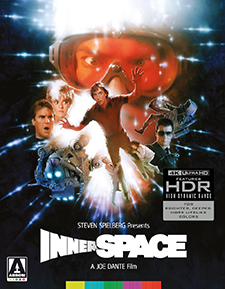
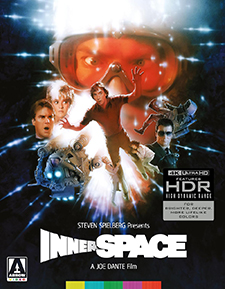
The Arrow Video Limited Edition 4K Ultra HD release of Innerspace sits in a black Amaray case with a double-sided insert, featuring new artwork by Doug John Miller on the front and the German theatrical poster artwork by Renato Casaro, which was also used for its home video release, on the reverse. Alongside it is a double-sided fold-out poster featuring one of the theatrical poster artworks by Morgan Weistling on one side and a re-creation of the humorous “board game” concocted by the Warner Bros. publicity department for a proposed contest tie-in on the reverse. Also included is a 60-page booklet featuring the essays The Crippled Tomcat by Andrea Subissati, “See yourself being a hero, Jack?”: The Short Truth of Innerspace by Josh Nelson, Ain’t He a Stinker? Duck Amuck, Innerspace, and the Impossibilities of Joe Dante by Jessica Scott, Dante and Goldsmith: Looney Tunes and Merry Melodies by Charlie Brigden, The Ins and Outs of Innerspace: An Interview with Joe Dante by Michael Doyle, Dante’s Players by Scott Saslow, a re-creation of the original exhibitors pamphlet, presentation information, production credits, special thanks, and just for fun, an illustration of the lab-based shrinking project on the front cover by Doug John Miller, and a VHS advertisement on the reverse—with Martin Short, Dennis Squad, and the experimental rabbit sandwiched between tapes of Lethal Weapon and The Color Purple. All of this material is housed in side-loading hardbox packaging with a thin slipcover, both of which feature the Morgan Weistling artwork. The following extras are included on the disc itself:
- Audio Commentaries:
- Joe Dante, Michael Finnell, Dennis Muren, Kevin McCarthy, and Robert Picardo
- Drew McWeeny
- Shrinkage: The Making of Innerspace (HD – 58:53)
- Joe Dante’s Behind the Scenes Video Compilation (Upscaled SD – 23:32)
- ILM Behind the Scenes (SD – 20:16)
- Storyboard Gallery (HD – 96 in all – 8:27)
- Polaroids: Continuity & Behind the Scenes Gallery (HD – 120 in all – 10:23)
- Production Stills (HD – 172 in all – 14:34)
- Poster Gallery (HD – 15 in all – 1:37)
- Theatrical Trailer (Upscaled SD – 1:31)
First up is the archival commentary recorded for the 2002 DVD release, which features Joe Dante, producer Michael Finnell, visual effects supervisor Dennis Muren and actors Kevin McCarthy and (in the second half of the commentary) Robert Picardo. There are a few gaps where the film’s soundtrack kicks in here and there, but it’s an otherwise informative and highly entertaining track, as Joe Dante-driven commentaries tend to be. Dante and Finnell do most of the talking, with everyone else interjecting at key points, making for a very natural conversation about the film while they all watch it together. The new audio commentary features film critic and screenwriter Drew McWeeny, which frankly is mediocre territory as it’s mostly reactionary. What information about the film and its creators is brought to the table can be learned elsewhere in the extras. He’s very game and keeps things moving, but at the same time it feels hollow compared to the other track.
Shrinkage: The Making of Innerspace is an excellent new documentary by Heather Buckley about the film, featuring interviews with Joe Dante, producer Michael Finnell, visual effects supervisor Dennis Muren, actor Robert Picardo, and visual effects artists Bill George and Harley Jessup. They discuss the genesis of the project, the casting process, many of the issues with the film and the studio along the way, its extensive special effects sequences, and the eventual and disappointing theatrical release, with Joe Dante closing by proclaiming “Long live home video.”
Next is a set of videotaped behind the scenes material, some of it shot on the set with Joe Dante’s home movie camera, and the rest shot by Dennis Murren at Industrial Light & Magic. We get to see plenty of candid moments with the cast and crew, who clearly had a wonderful time making the film. Several image galleries follow, one dedicated to storyboards, another featuring Polaroids taken on the set, another containing a set of production stills, and the last delving into the film’s posters and promotional materials. Altogether it’s 403 images total, which is massive. Last is the theatrical trailer.
Besides any vaulted TV and radio spots, there isn’t much leftover material out there to mine for extras. There are several interview segments on Youtube, specifically from The Bobbie Wygant Archive, which includes segments with Dennis Quaid, Martin Short, Meg Ryan, Joe Dante, and Michael Finnell. There was also a Japanese CDV promotional soundtrack release containing a promotional video for the film, plus the music video for Twistin’ the Night Away by Rod Stewart which closes the film. It’s a shame that Dennis Quaid, Meg Ryan, and Martin Short are a part of the main extras, but it’s still quality material without them.
Arrow Video’s 4K UHD release of Innerspace is outstanding, giving the film the tender love and care that it has so desperately needed on home video. For fans of Joe Dante’s filmography, this is definitely one to add to your library. Most highly recommended.
- Tim Salmons
(You can follow Tim on social media at these links: Twitter, Facebook, BlueSky, and Letterboxd. And be sure to subscribe to his YouTube channel here.)