
Killer, The (4K UHD Review)

Director
John WooRelease Date(s)
1989 (April 29, 2026)Studio(s)
Golden Princess Film Production (Imprint Asia/Via Vision Entertainment)- Film/Program Grade: A
- Video Grade: A-
- Audio Grade: B+
- Extras Grade: A+


Review
[Editor’s Note: This is a Region-Free Australian 4K Ultra HD Blu-ray import.]
If John Woo’s final Hong Kong film Hard Boiled ended up being Woo at his least restrained, unleashing all of his proclivities as a filmmaker and amplifying them to the Nth degree, his previous film The Killer (aka Dip huet seung hung) is still Woo at his most iconic—which shouldn’t be surprising, considering how much that it’s filled with blatant iconography including churches, crosses, and white doves. Woo has always been open about his Christian faith, and that came to the fore with the redemption story that he told in The Killer—which also helped shape the visual style that he developed for the film (and has used ever since). A Better Tomorrow may have been his splashy entrance into the Hong Kong New Wave, but The Killer is what turned John Woo into John Woo. It may or may not be the pinnacle of his career, but it’s arguably the real dividing point between his earlier work and everything that has followed.
Still, Woo being Woo, as redemption stories go, The Killer is a particularly perverse one. Ah Jong (Chow Yun-fat) is a professional hitman with a long trail of dead bodies behind him. He wants to leave the life, so he has his old friend Fung Sei (Chu Kong) arrange one last job for him. That goes awry when Ah Jong accidentally blinds singer Jennie (Sally Yeh) during a shootout, and he’s so wracked by guilt that he disguises himself in order to help her regain her vision via an expensive cornea transplant. At the same time, he finds himself in the crosshairs between maverick police detective Li Ying (Danny Lee) on one side, and the ruthless Triad boss Wong Hoi (Shing Fui-on) on the other. Yet while Ah Jong and Li Ying are on opposite sides of the law, they share common ground together and quickly develop a grudging respect for each other. That ultimately puts both of them on the wrong side of Wong Hoi, with Jenny’s life (and vision) hanging in the balance. The Killer also stars Kenneth Tsang and Ricky Yi Fan-wai.
While Woo didn’t approve of the criminal lifestyles that he presented in his films, he clearly felt an affinity for Ah Jong. Despite his Lutheran upbringing, Woo makes films that are awash in levels of ultraviolence that would make even Alex DeLarge blush. Similarly, Ah Jong is deeply religious even though his job involves mass murder in suitably ultraviolent fashion. He wants to leave the life of a killer behind him, but whether he realizes it or not, he still has to atone for his sins in one way or another. He may have sublimated his guilt over all of those killings since his targets are never really innocent victims, but after he accidentally disfigures the innocent bystander Jenny, he’s consumed with guilt about it. Helping to restore her vision becomes a way for him to redeem his past. Still, the price for Christian redemption always involves blood, and Ah Jong doesn’t realize just how far that he’s going to have to go to wipe out the stain of his sin.
The Killer wears its influences on its sleeve, from Woo’s Christianity to Jean-Pierre Melville’s Le Samouraï and the crime films of Martin Scorsese, but there’s another influence on Woo’s story that rarely gets mentioned: Charlie Chaplin’s City Lights. In that film, the Little Tramp becomes obsessed with a blind flower girl who has mistaken him for a wealthy patron, and he sacrifices everything in order to raise the money for an operation in order to restore her vision. Yet he’s still ashamed of what he is, so he keeps up the ruse with her of being a millionaire. He wants her to see, but he doesn’t want her to see what he really is. In the end, with her sight restored, he prepares to fade off into the distance, but her vision is clear enough to go beyond superficial textures and see through to his overflowing heart.
Like the Little Tramp, Ah Jong doesn’t want Jenny to know what he is, especially since he’s the one responsible for her plight. In other words, he wants to help her despite the fact that he thinks she won’t accept him once she finds out who he really is. Yet like the flower girl, Jenny can see past his murderous exterior and even her own pain in order to understand the goodness in his heart—it may be buried deep, but it’s still there. Li Ying can see it as well, so he ends up torn between his mission to bring Ah Jong to justice and his desire to see the killer complete his redemption arc by helping Jenny. Ah Jong and Li Ying end up forming one of Woo’s patented unholy duos, but with the intersection between the two of them being Jenny, it’s really more of an unholy trinity (and that’s not even counting the villain this time). The Killer may display influences as varied as Melville, Scorsese, and Chaplin, but there’s also a shade of Sergio Leone present in the way that the characters are structured.
However, Woo once again being Woo, the redemption story in The Killer doesn’t work out the same way that City Lights did. Jenny may be able to see into Ah Jong’s heart, but it won’t be with her eyes. Li Ying grows to understand him as well, but Ah Jong’s sins run too deep for him to be able to atone for his past without paying the price in blood. However noble his intentions toward Jenny may be, that’s not enough for Woo’s moral balance sheet. And if Jenny is ever to have her vision restored, Ah Jong won’t be the one to make it happen. That’s ironic considering the works-oriented nature of Woo’s Lutheran faith, but Ah Jong’s good deeds with Jenny simply won’t be enough either to redeem him or to save her. As a result, The Killer has one of the bleakest endings of Woo’s entire career. Instead of the iconic closeup of the Little Tramp’s hopeful face at the end of City Lights, The Killer ends with one of the most hopeless images that Woo ever crafted. Yet it’s no less iconic, and so it’s part of what makes The Killer into Woo’s most iconic film (the white doves are just the icing on the cake).
Cinematographers Peter Pau and Wing-Hang Wong shot The Killer on 35mm film using Panavision cameras with spherical lenses, framed at 1.85:1 for its theatrical release. This version uses the same master as the Shout! Studios release, which is based on a 4K scan of the original camera negative with digital restoration and grading performed by Duplitech (both Dolby Vision and HDR10 are included). While it’s a different encode here, any actual differences between the two in motion are minimal. (Note that while Via Vision uses the same grade as the Shout! versions of all these Golden Princess titles, Arrow has been altering the grades for many of them, but that’s a discussion for another day.)
There’s some instability during the opening logos, and unlike Hard Boiled, the credits don’t look like they’ve been recreated digitally against a clean background plate—they look like optical dupes this time. That’s going to be a running theme here since Woo’s films from this era relied heavily on optical work like dissolves, freeze frames, superimpositions, and other such effects. They weren’t cut in, either, so the entire leading and trailing shots were affected (at least this time Woo used high-speed cameras on set, so there isn’t as much step-printed slow motion). All of that material looks as soft as you would expect, and there’s some diffusion in the rest of the cinematography, but everything else looks as sharp and detailed as it can. While there are a few light scratches and other damage marks in some of the opticals, the rest of the film looks clean aside from a stray hair that appears at the bottom edge of the frame in at least one shot. Speaking of which, the image is sharp enough here that it’s really easy to make out the long mole hair on Danny Lee’s face—once you’ve seen it, you won’t be able to stop seeing it in each and every shot. (4K resolution can be for good or for ill sometimes.)
The colors all look accurate, and they haven’t been boosted artificially to make a more dramatic HDR grade. The Killer tends to be muted overall, but there are some rich (but relatively restrained) colors in the background of the cityscapes, especially in the night shots. Pau and/or Wong relied heavily on practical light sources like table lamps and streetlights, and they all have just enough glow without appearing too blown out. None of Woo’s Hong Kong films are ever going to be dazzling in 4K, and The Killer is no exception, but this is still a clear upgrade over all previous home video versions of the film. It’s not demo material, but it looks exactly like it should.
Audio is offered in Cantonese 2.0 mono LPCM and 7.1 DTS-HD Master Audio; Mandarin 5.1 DTS-HD Master Audio; and English 2.0 mono LPCM, all of them with optional English subtitles. Unlike the relatively restrained 5.1 remix that Via Vision offered for Hard Boiled, this 7.1 track contains added sound effects. Some of those are fairly minor, and the simpler nature of the first gunfight relies mostly on the original sound effects. But as the gunplay gets more elaborate, so does the remix, with the original effects being drowned out by the new ones. That does mean that there’s deeper bass and more dynamic impact, but it’s at the expense of the original sound effects. It’s well done as such things go, but I still preferred the original mono mix. It might have just a touch of distortion in Lowell Lo’s iconic opening title theme (although it may simply be the nature of the synthesizers that he used), but other than that, everything else sounds clean with no other artifacts of note. Like most Hong Kong cinema from that era, The Killer was shot MOS with no sound recording on set, so the dialogue is all post-synced and doesn’t always integrate well into the soundstage. But that’s the nature of the beast.
(Note that the subtitles in this version have been newly translated in a more literal form, so Ah Jong and Li Ying no longer refer to each other as Mickey Mouse and Dumbo, Butthead and Numbnuts, or Tom and Jerry like they do in various other subtitled versions. Here, they call each other Shrimp Head and Little B, which is a more literal translation from the Cantonese, although their intent does get lost in translation since those phrases won’t have any meaning for western audiences.)
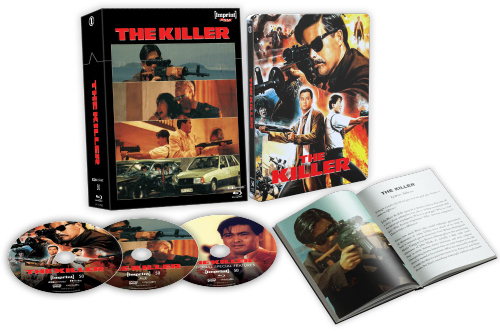
Via Vision’s Region-Free Limited Edition Steelbook 4K Ultra HD release of The Killer is #50 in their Imprint Asia line, and it’s limited to 1,500 units. It’s a two-disc set that includes a Blu-ray with a 1080p copy of the film, as well as a 60-page hardbound booklet featuring essays by Sean Gilman and Brian Tallerico. Everything comes housed in one of Imprint’s rigid Hardboxes that opens up at the top. The following extras are included:
DISC ONE: UHD
- Commentary by John Woo and Drew Taylor
- Commentary by David West
- Commentary by John Woo and Terence Chang
- Commentary by John Woo
DISC TWO: BD
- Commentary by John Woo and Drew Taylor
- Commentary by David West
- Commentary by John Woo and Terence Chang
- Commentary by John Woo
- The Hero of Heroic Bloodshed (HD – 74:19)
- A Bullet Ballet (HD – 44:45)
- My Kind of Hero (HD – 6:06)
- Editing The Killer (HD – 11:58)
- Hong Kong Confidential: Inside The Killer (HD – 11:32)
- Deleted and Extended Scenes (HD & Upscaled SD – 11:40)
- Image Gallery (HD, 84 in all)
- Trailers (HD – 6:02, 2 in all)
With the exception of fourth commentary track with John Woo and Terence Chang, the rest of the extras on the second disc are all carried over from the Shout! Studios UHD set. The first two commentaries were newly recorded for Shout!, starting with one that pairs Woo with The Wrap journalist Drew Taylor, who acts as a moderator. Woo says that The Killer is one of his favorites of his own films, and thanks Tsui Hark for giving him the creative freedom to make it. They discuss his inspirations like Le Samouraï, with Woo explaining that he was impressed by the way that Jean-Pierre Melville conveyed emotion visually. He admits that he never liked planning too much in advance, but prefers to work things out on set. He tells plenty of stories about how he did just that, including why he felt that it was necessary for the film to have a tragic ending. The nearly 80-year-old Woo is a little difficult to follow sometimes, but his memories are sound, so it’s an interesting track.
The second Shout! commentary features critic David West, author of Chasing Dragons: An Introduction to the Martial Arts Film. He refers to The Killer as being the apotheosis of Woo’s “heroic bloodshed” style, and also explains Woo’s many influences like Le Samouraï and various Japanese yakuza films (both Woo and West comment on Ken Takekura’s influence). West provides some historical context (it had the misfortune of being released barely a month after the Tiananmen Square massacre), notes all of the nods to Melville’s film, and breaks down The Killer on a thematic level. Bringing everything full circle, he also notes some of the later films that have been influenced by Woo. West has a low-key manner of speaking, but he knows his stuff, so this is also a good listen.
The archival “group” commentary is from the 1993 Criterion Collection LaserDisc (which was ported over to their 1998 DVD), and it’s a rare example of Criterion commentary from that era being licensed out elsewhere. It’s one of Criterion’s patented curated tracks, with Woo and producer Terence Chang recorded separately and edited together. Woo dominates the track, discussing not just Le Samouraï but also the way that he was inspired by how Martin Scorsese used slow motion, not as a means of drawing out the action, but rather to express emotion. Chang offers some practical details about making the film. This was just four years after Woo and Chang made The Killer, so their memories were even fresher than in the new commentary and interviews, making this an invaluable archival inclusion.
The archival solo commentary with Woo (omitted from the Shout! set) was originally recorded for the 2000 DVD from Fox Lorber While it understandably covers similar territory to the other commentaries, like the Criterion track, it was recorded barely a decade down the road from the production of The Killer, so Woo’s memories were still pretty fresh. He opens by acknowledging his debt to Martin Scorsese and Jean-Pierre Melville, and notes how Ah Jong finding sanctuary at the church was a personal element for him since he also found peace and serenity visiting churches. That sets the tone for the commentary as a whole, which is laid-back, contemplative, and focused on spirituality. With no moderator on hand, Woo does lapse into silence occasionally, but it’s still worth checking out.
The rest of the extras on this disc were produced by High Rising Productions and Ballyhoo Motion Pictures. The Hero of Heroic Bloodshed is a feature-length documentary that traces Woo’s entire career from his early wuxia films forward, with a natural emphasis on his Hong Kong New Wave films like The Killer. It includes interviews that examine Woo’s work from within and without, with Woo and stuntperson Bruce Law covering the former, and a cornucopia of others who provide insights about the latter: critics Kim Newman and James Mudge; producer/writers Michael Colleary and Mike Werb; producer Lori Tilkin de Felice; director Roel Reiné; and academics like Luke White, Chen-Yu Lin, and Victor Fan. They address the themes in his films and his incomparable style, including a digression into his rare forays into explicit political commentary with Bullet in the Head (the subject of Tiananmen Square comes up again). Woo’s American period is also included, as his return to Hong Kong and eventual return to Hollywood once again. It’s a great overview of the career of one of cinema’s most iconic artists.
There are also four new interviews starting with A Bullet Ballet, which is an extended session with Woo. He emphasizes the improvisatory multi-camera nature of his Hong Kong filmmaking, his own Christianity, and how The Killer ended up expressing themes of redemption and forgiveness that many of his collaborators didn’t understand (his original cinematographer Peter Pau quit halfway through the shoot). My Kind of Hero is with Terence Chang, who breaks down the arduous process of making the film on location with a relatively low budget and long work days. He feels that The Killer is the film where Woo developed his signature style, much more so than on the A Better Tomorrow films. Editing The Killer is with music editor David Wu, who explains the process of fusing Lowell Lo’s score and the songs with Woo’s imagery. Hong Kong Confidential is another installment with with Grady Hendrix, co-author of These Fists Break Bricks, who says that The Killer is the movie where John Woo became John Woo. But getting there wasn’t easy, and Hendrix explains the difficulties that Woo faced in mounting the production and securing its iconic cast.
Finally, in addition to Trailers and an Image Gallery, there’s also a collection of Deleted and Extended Scenes that consists of alternate and extended footage that was used in the Mandarin-language Taiwanese cut of the film. It’s not all-inclusive of every single difference between the two versions, but it does comprise the most noteworthy changes. (The footage has been cut into the existing scenes from the new 4K master, so it’s easy to tell which shots are the added ones.)
That’s it for the Shout! Studios and Fox Lorber extras, but Via Vision has only just begun:
DISC THREE: BD
- Extended Taiwanese Cut (Upscaled SD – 136:27)
- The Killer: Birth of a Romantic Killer (Upscaled SD – 32:15)
- Interview with Chow Yun-Fat (Upscaled SD – 19:50)
- Interview with Sally Yeh (Upscaled SD – 24:21)
- Interview with Kenneth Tsang (Upscaled SD – 24:44)
- Interview with John Woo (SD – 23:47)
- Interview with Peter Pau (Upscaled SD – 14:06)
- American Cinematheque Q&A with John Woo (SD – 35:01)
- Location Guide (SD – 8:47)
- Code of Bullets: The Killer – Perfect Selection (Upscaled SD – 10:23)
While Shout! only included the montage of deleted and extended scenes from the Taiwanese cut of The Killer, Via Vision is also offering the whole thing, upscaled from SD. It’s presented open-matte 1.33:1, with audio in Mandarin 1.0 mono Dolby Digital. Unlike the Taiwanese cut that Via Vision included with Hard Boiled, this one looks like it’s a VHS rip, so it’s in considerably rougher shape, but that also means it’s the extended-extended cut, since that version added more scenes that weren’t in the Taiwanese theatrical version. It’s filled with dropouts, tracking errors, and other analogue tape artifacts, and the resolution wasn’t that good to begin with, so it is what it is. Still, while the montage of alternate scenes is still included here so that you can cut to the chase and see the major differences, it’s arguably better to see them in context, and without the switching back-and-forth between upscaled SD and remastered HD. (As always, see the Movie-Censorship website for a complete breakdown of the differences.)
Via Vision has also collected the majority of the extras from previous domestic and international releases of The Killer, including one from the 2001 DVD from HK Video in France. The Killer: Birth of a Romantic Killer is a documentary on the making of the film, featuring interviews with John Woo and Tsui Hark. It delves into The Killer on a thematic and stylistic level, exploring the techniques that Woo used in order to express the romanticism at the heart of the film.
There are also three different interviews that were produced for the 2002 DVD from Hong Kong Legends—although there’s a twist with two of them. The Sally Yeh and Kenneth Tsang interviews are both compilations of two different sessions, the second of which came from a Hong Kong Blu-ray from Kam & Ronson Enterprise instead (in each case, the first session is in English and the second is in Cantonese.) Yeh says that she was always in the right place at the right time, and getting hired for The Killer was no different. She was already contracted to Tsui Hark, so the doors opened for her easily. Kenneth Tsang says that Woo uses his camera like writers use a pen, as way of telling the story. Peter Pau is the odd person out here, as he was only interviewed for the Hong Kong Legends disc. He offers his own perspective on his complicated (and truncated) working relationship with Woo on The Killer.
Speaking of odd things out, Via Vision has included another installment of Code of Bullets, this one focusing on the weapons and ammunition in The Killer. These were produced in 2004 for Star TV and have appeared on a variety of different Hong Kong DVDs, but it’s not clear which one came first.
Finally, there’s an interview with John Woo and a couple of featurettes that were first included on the 2010 Dragon Dynasty Blu-ray. The Woo interview naturally covers similar material to his other interviews and commentaries in the set, but there’s also a Q&A with Woo that took place at a screening of The Killer hosted by the American Cinematheque. It’s not dated, but it took place somewhere between 1992 and 2005, when Dennis Bartok was serving as head of programming. (I found one source online that identifies it as being from 2002.) Bartok acts as moderator, looking impossibly young and fresh-faced (no beard!). Woo identifies his inspirations for the story and breaks down the making of the film, including working with Lowell Lo on the score. The Location Guide is hosted by Kea Wong, who takes viewers on a journey through the original locations from the film and showing how much that they had already changed.
That’s all of the previous Shout! Studios extras and most of the remaining archival ones, but as overwhelming as all of that may be, there are still a few things missing here from previous releases. Criterion’s CAV LaserDisc also included trailers for ten of Woo’s other Hong Kong films and a still-frame supplement with biographical information and a guide to Hong Kong cinema (it’s a shame that Criterion doesn’t offer their old still-frame extras anymore). The 2002 Hong Kong Legends DVD also included a commentary with Bey Logan (but to be fair, that’s probably never going to see the light of day again.) The 2026 UHD set from Metropolitan Film in France added the documentary HK Revisited Episode 3. Arrow’s 2026 UHD offers an Atmos remix, the English-language credit sequence, and three different versions of the Taiwanese cut: the original theatrical version, the theatrical version with inserts from the extended VHS, and a “consistent quality” version that’s a straight VHS rip (the latter being the one that’s included here).
So, to sum up, this Via Vision UHD set for The Killer is a clear winner over the Shout! Studios and Metropolitan Films UHDs thanks to their inclusion of an additional disc of archival extras. Where things get a bit more complicated is in comparison to Arrow. While your mileage may vary regarding their Atmos remix and alternate grading, if you want all three versions of the Taiwanese cut, then they’re the best option. But frankly, the only one that matters to me is the “fully” extended VHS version that’s included here, and it’s more watchable in consistent quality than it is awkwardly switching back-and-forth between HD and upscaled VHS. (Check out the Deleted and Extended Scenes here to see what I mean.) Arrow otherwise has all of the same Shout! Studios and archival extras, with the exception of the “second” interviews with Sally Yeh and Kenneth Tsang from the Kam & Ronson Enterprises Blu-ray. So, if you take the two additional versions of the Taiwanese cut out of the equation, Via Vision technically has slightly more extras. It all comes down to personal preference, and in my case, I lean toward Via Vision, especially when you throw the Steelbook packaging and Hardbox into the equation.
Regardless, Grady Hendrix said it best: while Hard Boiled may be the Wooiest Woo movie that John Woo ever Wooed, The Killer is still the movie that made John Woo into the John Woo that fans know and love. It’s an essential addition to any comprehensive film library.
-Stephen Bjork
(You can follow Stephen on social media at these links: Twitter, Facebook, BlueSky, and Letterboxd).