
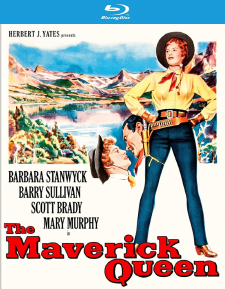
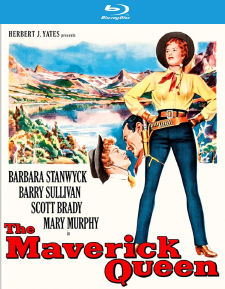
Maverick Queen, The (Blu-ray Review)
Director
Joseph KaneRelease Date(s)
1956 (July 21, 2026)Studio(s)
Republic Pictures/Paramount Pictures (Kino Lorber Studio Classics)- Film/Program Grade: B-
- Video Grade: A-
- Audio Grade: A
- Extras Grade: B-

Review
Republic Pictures was on its last legs in 1956. The studio’s bread and butter were B-Westerns and serials, movie types made obsolete by the advent of television. Former Republic stars Gene Autry and Roy Rogers had already made the move into television, while the company’s biggest name, John Wayne, had gone independent, moving his production company over to Warner Bros. Republic might have survived in the long-run had they gotten into television early and in a big way, or had they adjusted their production program to the rapidly changing trends of the ’50s, but the company had always been overly cautious.
With The Maverick Queen (1956), the company belatedly attempted to follow industry trends, but by then it was too late. In part, the film is an attempt to compete with A-level Westerns, but the result is an extraordinarily average Western. Resistant to the wide screen revolution earlier in the decade, it was also their first foray into true widescreen, the film debuting their Naturama process. Essentially a variation of CinemaScope, it used anamorphic lenses modestly superior to Fox’s Bausch & Lomb, with the added advantage of simultaneous focus of both the anamorphic attachment and the primary lens attached to the Mitchell cameras. For movie audiences, however, the difference was imperceptible.
Nevertheless, The Maverick Queen appears to have been a modest hit for the company, and may have had a hand in inspiring Fox to reteam its stars, Barbara Stanwyck and Barry Sullivan, for Samuel Fuller’s more energetically directed Forty Guns the following year.
Adapted from Zane Grey’s novel, mysterious stranger Jeff Young (Sullivan) turns up one evening at the chuckwagon of rancher Lucy Lee (Mary Murphy) and cook Jamie (Wallace Ford), hoping for a meal. The Sundance Kid (Scott Brady) and his gang also turn up, threatening Lucy and her cattle, but the gunslinger-like Jeff drives them off. Jeff helps Lucy bring the cattle into town, and she wants to hire on Jeff permanently, but he has other plans.
Sundance also heads to town where Kit Banion (Stanwyck), owner of most of the town including its saloon, The Maverick Queen, is secretly working as a go-between with Butch Cassidy & the Sundance Kid’s Hole in the Wall Gang. At the bar, she becomes attracted to Jeff and, assuming Jeff Young is really Jeff Younger of the Younger gang, hires him on, upsetting Sundance, Kit’s jealous boy-toy (Scott Brady was a good 15 years younger than Stanwyck), though he’s on the outs with her. Jeff proves his mettle when the gang stages a daring train robbery, but Jamie, secretly spying for Kit, is suspicious of Jeff’s identity, especially when another stranger (Jim Davis) rides into town who might possibly be the real Jeff Younger.
Though competently made, The Maverick Queen offers not a single surprise or variation on Western genre tropes. It is utterly predictable from beginning to end, this at a time when the Western genre was rapidly evolving in several different directions. Indeed, if one were to string every movie Western from end-to-end, from best-to-worst, The Maverick Queen could function as its median entry. While not at all bad, nothing about it is remotely exceptional, either.
In her middle-age, Stanwyck found starring roles in major films harder to come by, accepting secondary parts in big studio productions like Executive Suite (1954) and These Wilder Years (1956), starring roles in lesser-studio fodder like Escape to Burma (for a dying RKO, 1955), and like former big-league male stars of her generation, such as Randolph Scott and Joel McCrea, carved a niche doing mid-level Westerns. After co-starring with Ronald Reagan in the infamous Cattle Queen of Montana (1954), Stanwyck did this and Forty Guns in quick succession. She then headlined four episodes of TV’s Zane Grey Theatre, episodes of Wagon Train and Rawhide, before landing The Big Valley, the signature role of Stanwyck’s later career. After a long dry spell, she came back again on the television miniseries The Thorn Birds, which led to a final starring role, on the Dynasty spin-off The Colbys (1985-86).
It would be interesting to learn the film’s budget which, given its location filming in Colorado, was more expensive than the usual Republic feature, though likely significantly less expensive than, say, the typical Anthony Mann-James Stewart Western. At a guess I’d say probably in the $750,000-$1 million range; a lot of money for Republic, average for a big studio color Western.
Kino’s Region “A” encoded Blu-ray, licensed from Paramount, inheritors of the Republic library, is a 4K scan of the original negative, and presented in its original 2.35:1 aspect ratio. The image is par with other good transfers of mid-’50s color and ’scope titles. Republic, really a subsidiary of the Consolidated Film Industries, did their own lab work, releasing this is “TruColor,” which also comes off reasonably well. The DTS-HD Master Audio (2.0 mono) is fine, and optional English subtitles are provided.
The lone extra is a new audio commentary by film historian Dwayne Epstein, better researched and organized than most.
Though not without interest, it’s a shame The Maverick Queen is so ordinary and predictable. Like the trades used to say, “undemanding audiences” may like it, but it’s routine in the extreme.
- Stuart Galbraith IV