
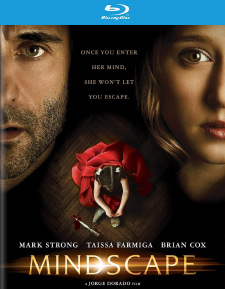
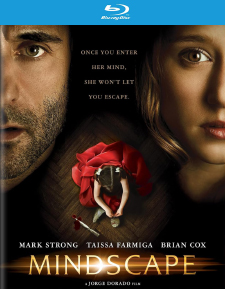
Mindscape (Blu-ray Review)
Director
Jorge DoradoRelease Date(s)
2013 (September 15, 2026)Studio(s)
The Safran Company/Antena 3 Films/Ombra Films/Roxbury/StudioCanal (Kino Lorber Studio Classics)- Film/Program Grade: C
- Video Grade: B-
- Audio Grade: A
- Extras Grade: B

Review
Entering a person’s consciousness forms the plot of the films Inception, Dreamscape and The Cell, which take the viewer into an alternate world while remaining grounded in the here and now. In Mindscape, a memory detective is assigned to enter a teenage girl’s mind to resolve a trauma.
John Washington (Mark Strong) is a top detective for the Mindscape agency, highly skilled at entering and seeing the memories of others. He’s also suffering emotional distress and grief following the suicide of his wife. Returning to Sebastian Cunningham (Brian Cox), head of the agency, after a long absence John asks for work because his funds are nearly tapped out. Sebastian assigns him to the case of Anna Greene (Taissa Farmiga), the 16-year-old daughter of a wealthy family who has locked herself in her room and refuses to eat.
John slowly gains Anna’s confidence and discovers that she’s extremely intelligent. When he enters her memories to determine the root of her problem, he learns how Anna had been the center of suspicious incidents including child molestation and the poisoning of classmates. After wading through this complex of memories, John cannot be certain whether Anna was an innocent victim or is feeding him false memories, but ultimately He becomes her advocate as her stepfather tries to have her committed to a mental institution.
Mindscape gave Mark Strong his first leading role. He plays John with a quiet sense of sadness, seldom smiling, with a downcast look. He bonds with Anna and wants to help. During his memory excursions, he hardly moves. He’s a silent observer, gathering information that might prove important in explaining Anna’s behavior. As John, Strong is soft-spoken, his eyes revealing that he’s constantly assessing his subject. His acting style is reminiscent of gumshoes in classic noir—chain smoking, heavy drinking, on the edge—but his laconic performance lacks dramatic spark. A better-known actor might have been more successful at engaging the viewer.
Though Strong is top-billed, it’s Taissa Farmiga who’s the centerpiece of the film. An excellent actress, she plays Anna with self-confidence laced with flirtation as she banters with John. As he’s trying to get a handle on her, she’s evaluating his motives. Her performance deliberately leads to questions. Is she a sociopath? Is she possessed? Is she purposely misleading John with false memories? Why is the stepfather so eager to send her to an institution? Farmiga keeps us guessing with her enigmatic performance and eerie energy.
Chemistry is that extra something that adds authenticity and engages viewers. If it’s present, it makes accepting the characters easier. The chemistry between Strong and Farmiga allows their characters’ psychological gamesmanship to resonate dramatically. We can see a bond gradually developing between John and Anna.
Unfortunately, the screenplay by Guy Holmes has excessive dialogue that often goes nowhere. This is a film that calls out for visualization. Though memory sequences are more interesting than the here-and-now ones, all are on the same dramatic level. Some limited special effects might have made the memory sequences shine, distinguishing them from the muted tone of the film.
Mindscape, a Spanish film shot in English and filmed mostly in Toronto, is also known as Anna. It was Jorge Dorado’s debut as director. It has the bones of a very interesting film, but Dorado’s execution of the screenplay misses the mark. Rather than build suspense as the film proceeds, it becomes laborious, even dull. Dorado creates atmospheric tension initially and later creates some doubts about Anna, but the film’s final third falls apart structurally. It becomes predictable, the denouement mundane. Its science-fiction premise becomes the basis for psychological thriller but it comes up short with the thrills.
Mindscape was shot by director of photography Oscar Maura on 35mm film with Arriflex cameras and lenses, processed by DeLuxe Laboratory, and presented in the aspect ratio of 2.35:1. Clarity and contrast are very good. Color palette ranges from darker hues when John is shown initially to brighter, sunnier tones in Anne’s bedroom. In the opening scene, lighting and a camera that tracks a young woman through a house suggest an often-used scene in many horror films. Cinematographer Maura’s failure to distinguish visually between the memory and reality sequences often leads to confusion. Maybe the director intended to blur the line between reality and memory, but the viewer can easily become disoriented.
There are two soundtrack options, English 5.1 and 2.0 DTS-HD Master Audio, with optional subtitles in English SDH. Dialogue is clear. Mark Strong’s quiet delivery never varies while Taissa Farmiga speaks in a more animated manner, much as a teenager would. Lucas Vidal’s score provides tension with arrangements that suggest noir thrillers of decades earlier. Late in the film, there are sounds of a chase, police sirens, and footsteps hurrying through a forest.
Bonus materials on the Blu-ray release from Kino Lorber Studio Classics include the following:
- Interview with Actors Taissa Farmiga and Mark Strong (10:49)
- Mindscape: Behind the Scenes (21:39)
- Deleted Scenes (16:38)
- TV Spots (:42)
- Trailers:
- Mindscape (1:42)
- Repo Men (2:35)
- The Snowman (2:25)
- Twisted (2:03)
- Suspect Zero (2:14)
- I’ll Sleep When I’m Dead (2:20)
Interview with Actors Taissa Farmiga and Mark Strong – Farmiga and Strong talk about what drove them to accept their roles. Strong explains that John is on a downward spiral. He’s flawed and trying to cope with adversity. Strong admired the short films of director Jorge Dorado, so that was a plus. A lead role offered Strong the chance to play someone with multiple facets. Farmiga says the script makes you wonder what’s going on with her character, Anna. Farmiga collaborated with director Dorado to make sure her performance had the right layers. The script presented a challenge because the actors had to stay aware of “a complicated chess game.” Both agree that Dorado was well prepared, completely focused, positive during filming, and open to their input. Everyone was professional and welcoming. Mindscape is a film about freedom. Anna and John are both trapped by the past. Only by coming together can they escape from their “spiritual cage.”
Mindscape: Behind the Scenes – The concept of “memory detective” is explained. The film plays with ambiguity. Crew members discuss costuming, composing the score, locations, and photography. Scenes of actual filming show the use of cranes, robotic cameras, and the laying of track for dolly shots. Digital effects were kept to a minimum and a few examples are shown. Actors discuss their characters and experiences on the set.
Deleted Scenes – These scenes were cut to eliminate extraneous dialogue and repetition, and to streamline the narrative.
TV Spots – Three brief teaser spots are included.
Mindscape has an intriguing, thoughtful premise but its execution is disappointing. Despite having two strong leads, it plays on a single note. After establishing tension, director Jorge Dorado undermines it by dragging out the narrative rather than building to a dramatic climax. The ending looks as if it was thrown together hastily. It lacks the careful structure of the earlier part of the film. The memory sequences are insufficiently distinguished from the reality scenes. The film never rises above being an odd hybrid of science fiction and thriller.
- Dennis Seuling