
Spencer Tracy Collection (Blu-ray Review)
Director
Fritz Lang/Jack Conway/King Vidor/John SturgesRelease Date(s)
1936/1940/1955 (February 17, 2026)Studio(s)
Metro-Goldwyn-Mayer (Warner Archive Collection)- Film/Program Grade: See Below
- Video Grade: See Below
- Audio Grade: See Below
- Extras Grade: B-
- Overall Grade: A-

Review
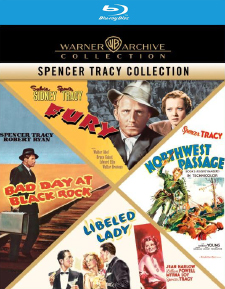
Yet another repackaging of four previously released Warner Archive titles, Spencer Tracy Collection is, as before, a good option for those who don’t already have one or more of the four titles included. In my case, for instance, I already had Bad Day on Black Rock (1955) but not Fury, Libeled Lady (both 1936) or Northwest Passage (1941) on Blu-ray.
Fury (1936) was Fritz Lang’s first American film. Revolving around a lynch mob, subject-matter-wise it’s like nothing MGM made before or after, and stylistically it’s much closer to Lang’s earlier German movies, particularly M (1931), only this time the target of the angry lynch mob is an innocent man. Even now, some 90 years since it was made, Fury is still harrowing and disturbing.
Tracy stars as everyman Joe Wilson, too poor to marry his sweetheart, the devoted and doting Katherine Grant (top-billed Sylvia Sidney). As the film opens she has accepted a job far from their Chicago roots, but Joe diligently works hard, with his two brothers, Charlie (Frank Albertson) and Tom (George Walcott), eventually buying a gas station, with Joe finally earning enough to reunite with his fiancée.
But en route to meet her Joe is arrested on flimsy circumstantial evidence tying him to the kidnapping of a child. (I don’t think the movie ever reveals the child’s fate but, clearly, it’s intended to remind viewers of the Lindbergh baby kidnapping.) Gossip spreads like wildfire in the small town where Joe is being held in the local jail. Whipped into a fury, the crowd quickly becomes uncontrollable. Too late efforts to disperse the mob with teargas and blockade the entrance are easily overcome, the townsfolk electing to burn down and even dynamite the entire municipal building with Joe trapped inside.
The 92-minute film is neatly bifurcated: the second-half of the film follows the trial of 22 townspeople, mostly men but including at least one woman, charged with murder. (Major spoilers) However, known only to Charlie and Tom is the fact that Joe miraculously survived the flames, but his hatred and desire for vengeance against those who so traumatized is so strong he’d rather remain legally dead and stay in hiding to insure the 22 accused face death just as he had.
The first-half of Fury is nigh perfect, quickly establishing the loving relationship between Joe and Katherine, and Joe’s faith in the straight-and-arrow, getting kid brother Charlie out of the racketeering business, the brothers rooming and working together toward a better life. The film also establishes Joe’s innately kind and gentle nature, rescuing a hungry stray dog (Terry, later Toto in The Wizard of Oz) and caring for its litter of puppies later. Once arrested, Joe is dumbstruck by the rush to judgement, and the picture is frighteningly authentic in showing how insatiably gossipy townsfolk and a rabble-rouser or two (including, intriguingly, an out-of-town strike breaker) can mutate into a bloodthirsty mob within a matter of hours. That nothing, really, has changed except perhaps the speed in which misinformation spreads keeps is as disturbing today as when Fury was new. Further, while it’s harrowing enough to have Spencer Tracy trapped like a rat in a cage as the flames close in, that he’s in there with his cute little dog makes it all the more agonizing.
The long trial making up the second-half of the picture is, conversely, quite dated. Modern audiences are savvier about courtroom procedures, after decades of shows like The Practice, The Good Wife/The Good Fight, and the Law & Order franchise. Here and there, these courtroom scenes ring inauthentic and even absurd, especially when the judge takes the witness stand in the very case he’s presiding over. Further, the narrative hinges on Joe remaining “dead” to ensure all those murder convictions, hiding out, because were he to come forward... what? The 22 would “only” be charged with attempted murder and face years in prison instead of the electric chair? Despite these quibbles, the second half is still pretty riveting, especially when newsreel evidence unequivocally puts the 22 at the crime scene.
Tracy is great, though better as the everyman in love with his girl, struggling as the world unjustly closes in on him, then he is as the unbending, obsessive “dead” man, righting an injustice no matter how much it chips away at his soul. MGM tinkered with the film a little against Lang’s wishes, the studio obviously altering Joe’s speech at the end, with the aim of a more conventional wrap-up, but the damage is only slight. Sylvia Sidney is as good as Tracy, she inheriting the kind of parts Lillian Gish had expertly played in the teens and ’20s. Sidney accepted a pay cut to do the film, and emotionally anchors the story once Joe has gone off the rails.
Originally released to Blu-ray in 2021, Warner Archive’s release offers an excellent video transfer of this black-and-white, 1.37:1 standard frame production, now 90 years since its original theatrical run. The DTS-HD Master Audio (2.0 mono) is excellent, and supported by optional English subtitles. As with all the discs in this set, it’s Region-Free.
Extras are limited to a trailer and a rewarding audio commentary by filmmaker Peter Bogdanovich, who intersperses excerpts from his 1965 audio interview with director Lang.
FURY (FILM/VIDEO/AUDIO/EXTRAS): A-/A/A/B
The screwball comedy classic Libeled Lady (1936) is an odd choice for a collection supposedly focusing on Spencer Tracy. When the film was made Tracy was still regarded as a top supporting, not leading player, though he was definitely on the cusp of big-time stardom. The billing order reflects this: Jean Harlow, then William Powell, Myrna Loy, and finally Tracy, with character star Walter Connolly awarded featured billing. Harlow was Libeled Lady’s biggest star in 1936, though she’s really the third lead. It’s really William Powell’s picture all the way, with Myrna Loy playing the female lead, and Tracy the fourth corner of this four-sided triangle.
When wealthy heiress Connie Allenbury (Loy) is falsely accused by the New York Evening Star of breaking up a marriage, she sues the newspaper for libel, to the tune of $5 million. Apoplectic, managing editor Warren Haggerty (Tracy) indefinitely postpones his wedding to Gladys Benton (Harlow) to focus all his energies trying to save his paper from financial ruin.
Hiring suave former reporter Bill Chandler (Powell), together they scheme to put Connie in an uncompromising position with Bill and have Bill’s outraged wife burst in on them, forcing her to drop the lawsuit. That Bill is unmarried is a minor concern: they arrange to have a very reluctant Gladys marry him until the suit is dropped.
But Connie, it turns out, is not so easily maneuvered. She’s immediately suspicious of Bill’s efforts to ingratiate himself with her rich father, J.B. (Connolly), claiming a shared passion for trout fishing, believing Bill to be a simple fortune hunter. Eventually, though Bill wins them both over, Connie falling for Bill but, unexpectedly, Bill also falls in love with her, complicating his plans with Warren. Further, in pretending to be a married couple in love, Connie also falls in love with Bill.
Though Tracy’s character generates a few laughs, mostly he plays straight man to the others and their increasingly convoluted relationships, though this also plays to Tracy’s strengths as a reactor. Yet despite this powerful foursome of talent, the picture belongs to William Powell; while Tracy was famous for his seemingly “effortless” acting, Powell all but owned this particular type of comedy and especially Powell’s screen persona in such films—elegantly unflappable, witty, and, like Tracy, seemingly effortless. He was rarely less than outstanding even in lesser films, and while Libeled Lady doesn’t quite make it into the top-tier of screwball comedies, it’s very good, with funny dialogue and effective digressions into slapstick (Bill struggling to show off his fishing skills to J.B.) and, of course, his great screen chemistry with Myrna Loy, this being their fifth of 14 films together.
Warner Archive’s Blu-ray was first released in 2020. The video transfer is very good, not quite great; this one may not have been sourced from the original nitrate camera negative as it’s a little grainier and rougher around the edges than other pristine MGM mid-1930s titles released by the label. Again, we have DTS-HD Master Audio 2.0 mono with optional English subtitles, and again the disc is Region-Free.
The better-than average extras begin with a real curio: Keystone Hotel (1935), a Vitaphone two-reel comedy (remastered in high-def) that reunites many stars of early Mack Sennett silent comedies, though Sennett, apparently, had nothing to do with this production. The cast includes Keystone Cops police chief Ford Sterling, cross-eyed Ben Turpin, Chester Conklin, Hank Mann, and Vivien Oakland, among others. Also included, but unfortunately up-rezzed from standard-def are the one-reel shorts New Shoes (1936), about two pairs of singing shoes; and Little Cheeser (1936), a black-and-white Happy Harmonies cartoon. Also included is a trailer and a 13-minute excerpt from Leo Is On the Air, with Libeled Lady promoted on that radio series.
LIBELED LADY (FILM/VIDEO/AUDIO/EXTRAS): A-/A-/A/B+
Somewhat forgotten today, Northwest Passage (1940) was a huge production of 1939, rivaling that year’s Gone with the Wind. Filmed in Technicolor at a cost of $2.687 million, it seems to have been MGM’s third most-expensive film up to the point; only the $4-million Ben-Hur (1925), the 1938 Marie Antoinette, at $2.926 million, and The Wizard of Oz, at $2.77 million, cost more.
As suggested by its onscreen title, Northwest Passage (Book 1: Rogers’ Rangers), an even bigger, two-part epic was originally planned. Adapted from Kenneth Roberts’s historical novel, the movie only covers the first half of the story; scripting problems, uncertainty over Tracy’s availability, and the grueling hardships the unit encountered on location in Idaho, near Payette Lake (though the film is primarily set in present-day New Hampshire and Vermont), resulted in the cancellation of any sort of “Book 2.”
In 1759 New Hampshire, aspiring painter Langdon Towne (Robert Young) returns home after being expelled from Harvard over a political cartoon, he studying to become a minister. His family is forgiving, but not so the father of his intended bride, Elizabeth Browne (Ruth Hussey). After loudly and drunkenly insulting king’s attorney Wiseman Clagett (Montagu Love) and Indian agent Sir William Johnson (Laurel & Hardy bad guy Richard Cremer), Towne and local woodsman “Hunk” Marriner (Walter Brennan) flee to the countryside, where they are more or less pressed into the service of Rogers’ Rangers, by Major Robert Rogers (Tracy) himself, he impressed by Towne’s map-making skills.
The Rangers are on a mission to destroy the hostile Abenakis tribe to the north, who have been ruthlessly scalping and torturing white settlers there, while the Rangers must also evade French forces. Most of the picture follows their long, arduous journey, which includes men like Sgt. McNott (Donald McBride), Lt. Avery (Douglas Walton), Lt. Crofton (Addison Richards), and Capt. Ogden (Truman Bradley, of Science Fiction Theater), many of whom are killed or go insane along the way.
Movies set in pre-Revolutionary War America are rare, and Northwest Passage impresses with its historical verisimilitude. The sets, including a big backlot area, and costumes all look authentic. With their dark green buckskins, Rogers and his Rangers resemble Errol Flynn’s Robin Hood, but paintings from the period show their uniforms to be historically accurate also. The money, as they say, is up there on the screen: the opening and closing scenes in Portsmouth, New Hampshire, are impressively lavish and evocative, there’s an enormous battle between the Rangers and the Abenakis Indians ending with the massive burning of a fort (oh, the carbon footprint of that!), and the very dangerous location scenes are highlighted by Rogers’s desperate creation of a long “human chain” to cross a raging river.
It’s all action and eye-candy, with minimal characterization, though even at 125 minutes interest never flags. That said, Tracy’s single-minded character is little more than determined, borderline ruthlessly so, but the audience never really gets inside his head, and by the end of the film it has learned virtually nothing about him otherwise.
Warner Archive’s Blu-ray, first released in 2024, is stunning. The Technicolor process is flawlessly rendered for this video transfer, with no alignment issues, brilliant color, and extreme clarity throughout. The DTS-HD Master Audio (2.0 mono) is also excellent, and like the other titles here optional English subtitles are provided.
Extras are limited to and trailer and Northward, Ho!, a one-reel short documenting the making of Northwest Passage, and which features clips from other big-scale MGM productions.
NORTHWEST PASSAGE (FILM/VIDEO/AUDIO/EXTRAS): A-/A/A/B-
Bad Day at Black Rock (1955) was a critical and commercial success—a $3.8 million return against its modest $1.3 million cost. It has remained a popular “classic” title, particularly since the era of LaserDiscs, when it first became available on home video in letterboxed format, showcasing its excellent use of early CinemaScope. It’s been described as a modern Western (or revisionist, or neo), a thriller, a social problem film, a crime film and even noir in some circles, exemplifying its almost undefinable characteristics.
Outwardly, on its surface, it’s a very entertaining and suspenseful story about a “one-armed man” (actually, two arms, one useless) determined to wrench out of a small desert town its Dark Secret while its criminal element plays with him like a mouse caught under its sharp claws. But what is it really about? A film about racism against Japanese-Americans, none of whom are ever seen and who leave no trace of ever having been there at all? My hunch is that this weird, wonderful, almost avant-garde adaptation of Howard Breslin’s short story Bad Time at Honda (1947) was a happy accident, an anomaly from a dying studio system inadvertently turning out a near-masterpiece.
Soon after the end of World War II, John Macreedy (Spencer Tracy) gets off a train at Black Rock, a tiny desert town of maybe a half-dozen buildings. So insignificant is Black Rock that it’s the train’s first stop there in four years. Most of its residents are seriously riled by Macreedy’s appearance, especially after he asks about a man named Komoko. (A minor but curious flaw here; no such family name exists in Japan. It’s like a Japanese movie with an American called Smithfuss.)
Local rancher Reno Smith (Robert Ryan) has henchmen Hector (Lee Marvin) and Coley (Ernest Borgnine) intimidate Macreedy, hoping he’ll skedaddle on the next train out. Others, like hotel clerk Pete (John Ericson), try denying Macreedy a room. Pete’s sister innocently rents Macreedy her Jeep but is admonished by Reno. Macreedy eventually locates Komoko’s homestead, burned to the ground, and wildflowers he finds nearby suggests a body is secretly buried there. When Macreedy tries contacting the state police or anyone else, the operator (Pete) tells him the “lines are busy.” The local sheriff (Dean Jagger), appointed by Reno, is a useless drunk, while the pessimistic local doctor, Velie (Walter Brennan), tries loaning his hearse to help Macreedy escape, but Hector has torn out all the wires.
Bad Day at Black Rock was director John Sturges’s breakout hit; he made only “A” pictures thereafter, often epic, all-star affairs. It’s undeniably well crafted, notable particularly for Sturges’s use of the still-new CinemaScope format. Though a little stagey at times, he positions and moves characters within the frame intelligently, while also using, aided by CinemaScope, the bleak desert landscape to isolate both the pitiful hamlet and Macreedy himself.
Outwardly, the suspense component is considerable: Tracy vs. Ryan and Marvin and Borgnine, each uniquely intimidating, with Tracy’s Macreedy not only a “cripple” but seemingly mild-mannered, anxious to avoid trouble yet perplexingly determined to get at the truth, even when his life is threatened. The most famous scene in the film, when at a café/bar, Borgnine’s Coley tries goading Macreedy into a fight, is absurdly resolved—Macreedy’s heretofore unknown mastery of judo and karate turn Coley into jelly. Yet somehow this works. Tracy’s acting and Borgnine’s menacing presence keep the scene interesting even after multiple viewings, but one can only imagine how gobsmacked 1955 audiences were.
The picture has an almost avant-garde theater aspect, with its few buildings suggesting abstract theater flats, and nothing else around for miles. (In some ways, it looks like a UPA cartoon.) The Beckett-esque dialogue by Millard Kaufman, with Macreedy meek but circumspect, unrevealing of his intentions, his relationship with the never-seen Komoko, while Ryan & Co. do their level-best to threaten him, really do give the picture an odd quality. Some observers liken Macreedy to Japan’s samurai tradition, and/or that the film’s underbelly exposes suppressed discrimination against the Japanese-Americans interred during the war, (MGM head Dore Schary had produced the interesting Go for Broke! four years earlier), yet the picture is bereft of any Japanese presence at all. Still others see it as an indictment of McCarthyism (!). Over the years, I’ve seen Bad Day at Black Rock six or seven times, and I still can’t quite get a handle on it.
First released to Blu-ray in 2017, Warner Archive’s Blu-ray still impresses nine years later. Derived from a 2K scan of the 2.55:1 image, it easily bests all previous home video versions by a wide margin, with better color, clarity, and no “CinemaScope mumps,” though Sturges rarely employs anything like close-ups. Around this period, MGM was often content with the Perspecta process but they apparently had faith in this production, originally giving it a 4-track magnetic stereo release, recreated well here in DTS-HD Master Audio 2.0 stereo with much directionality and audio directed to the surround channels.
Supplements consist of an audio commentary by Dana Polan, of USC’s School of Cinema-Television (my alma mater), a valid but very academia-type “reading” of the film. Also included is a trailer in remarkably good condition.
BAD DAY AT BLACK ROCK (FILM/VIDEO/AUDIO/EXTRAS): A-/A/A/B
As before, this set is a bargain if you don’t already have two or more of the films included. They’re all worthwhile, with mostly great transfers and a good introduction to Spencer Tracy’s MGM years. Highly Recommended.
- Stuart Galbraith IV