
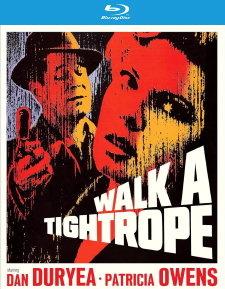
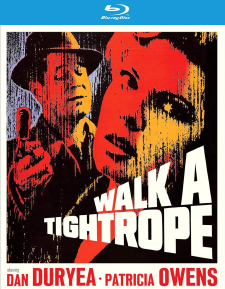
Walk a Tightrope (Blu-ray Review)
Director
Frank NesbittRelease Date(s)
1964 (July 28, 2026)Studio(s)
Jack Parsons-Neil McCallum Productions/Associated Producers/Paramount Pictures (Kino Lorber Studio Classics)- Film/Program Grade: A
- Video Grade: A
- Audio Grade: A
- Extras Grade: B-

Review
Murder mysteries grab us immediately. Who was the victim? What are the clues? Who is the killer? What was the motive? Outstanding examples include Murder on the Orient Express, Clue, and Knives Out. In Dial M for Murder, Alfred Hitchcock even managed to create suspense when the killer was known. A far more modest film, Walk a Tightrope is about a killer and his victim’s widow and a trial that brings to light new, shocking information.
Carl Lutcher (Dan Duryea), a down-on-his-luck American living in England, stalks Ellen Shepherd (Patricia Owens) on her way home from the cinema. He has a gun with a silencer, so it’s apparent he’s a professional killer and Ellen is his victim. He follows her home and when Ellen’s husband, Jason (Terence Cooper), answers the door, Lutcher shoots and kills him. Unknown to Lutcher, Jason’s friend, Doug Randall (Richard Leech), is also in the house.
When Doug hears the shots, he rushes in but is knocked unconscious by Lutcher. He comes to just in time to hear Lutcher demanding money from Ellen because she hired him to kill Jason. From this point on, the screenplay introduces a number of twists that keep the viewer guessing.
This British-American crime thriller begins with a frightened woman stalked by a dangerous man but quickly reveals itself to be a cleverly constructed series of deceptions, blackmail, and double-crosses, with Lutcher discovering that things are far more complicated and dangerous than they initially appeared. The screenplay by Mann Rubin presents intriguing puzzle pieces finally assembled by the film’s end, but the surprising climax isn’t at all telegraphed. Very often, twist endings can be figured out well before a story’s denouement. Not here. Walk a Tightrope will keep you riveted though it’s brief 69-minute running time.
Director Frank Nesbitt and screenwriter Rubin move the plot along quickly and use actual London locations to give the film local color. An early scene, in which Lutcher walks through his dingy neighborhood en route to his deadly assignment, already creates tension. Who is this guy? And where’s he headed? One of Duryea’s specialties was playing a sleazy, shady sort, and his portrayal here convinces that he’ll do anything—even murder—if the price is right. With a cocky attitude, a swagger that belies his low social station, and a toughness hewn by years of struggle, Lutcher grasps at the opportunity for quick cash despite the risk.
Patricia Owens gives Ellen an enigmatic quality. Her actions raise questions. Is she really the grieving widow, or did she have some part in her husband’s death? With a privileged bearing, she handles herself well when questioned by the police, yet the occasional close-up or sideways glance suggest she may not be as innocent as she claims.
It’s that uncertainty that drives Walk a Tightrope and keeps the viewer involved. The plot sets up a complex puzzle and takes us through twists and detours that shed light on what we previously witnessed. This is solid filmmaking. The script is constructed with care and never insults the intelligence of the viewer. The concise running time assures a streamlined narrative. Production values are modest. The film’s strength is the story and how convincingly the actors and director deliver it.
Walk a Tightrope was shot by director of photography Basil Emmott on 35mm black & white film with spherical lenses and presented in the aspect ratio of 1.37:1. The Blu-ray features the American version of the film with an aspect ratio of 1.85:1, taken from a 4K scan of the original camera negative prepared by Paramount Preservation. Clarity is sharp, with details well delineated, including whiskers on Carl Lutcher’s face, individual strands of Patricia Owens’ hair, buildings and cars in the London streets, and the spare courtroom. Blacks are deep and rich and the grayscale perfect for this noir-inspired murder mystery. Close-ups are used to emphasize certain lines of dialogue or to draw attention to reactions. The street scenes at the beginning open up the story and create suspense as Lutcher stalks his quarry. Production design is limited by the film’s low budget. Most scenes are studio-filmed interiors. With a film noir sensibility, Walk a Tightrope contains familiar visual noir tropes though it was made well after noir’s heyday ten years earlier. An especially effective series of shots focuses alternately on Lutcher’s face and feet as he heads to fulfill a lethal contract. In the film’s only flashback, we glimpse Lutcher’s penchant for violence.
The soundtrack is English 2.0 mono DTS-HD Master Audio. English subtitles are an option. Dialogue is clear, which is important in this dialogue-driven film. Buxton Orr’s score immediately sets the tone of the film as Ellen is being followed home, adding both suspense and menace. Rather than containing excessive exposition, dialogue tells the story in real time. Sound effects include two gunshots, car engines, ambient street noise, and footsteps pacing through a seedy London neighborhood.
Bonus materials on the Region A Blu-ray release from Kino Lorber Studio Classics include the following:
- Audio Commentary by Gary Gerani
- Trailers:
- Force of Evil (1:33)
- The Intruder (2:44)
- Lady on a Train (2:16)
- Nowhere to Go (1:41)
- One Way Street (2:12)
Audio Commentary – Film historian Gary Gerani says that Walk a Tightrope, a murder/mystery, is a co-production of English filmmakers and an American distributor. These were financially rewarding arrangements. Co-productions were often intended to accompany prestigious features which explains the film’s short running time. American actors “down on their luck” would often star in these pictures. The commentator is quick to add that Duryea worked regularly in films and television. The American version is shorter than the British version. A prologue featuring Lutcher in his apartment with his much-younger girlfriend was cut for the American release. Commentator Gerani reads excerpts from the script from this deleted scene. The aspect ratio was also altered. He says the British version is 1.66:1 (though IMDb lists it as 1.37:1), but the image was expanded to 1.85:1, which cropped some parts of the image but didn’t affect the overall look of the film. Dan Duryea has a weathered look with he’s perfect for the role. The film was shot in southwest London. Duryea’s appearance is unnerving and sets the mysterious tone. He’s “menace personified.” Career overviews are provided for Dan Duryea and Patricia Owens. Owens is best remembered for her role in The Fly (1958), a science fiction/horror classic. Duryea and Owens play overwrought characters believably. Viewers are forced to judge the situation only on the information they have. The trial provides additional facts. Though Ellen is a happily married newlywed, her state of mind is unclear. The location footage adds to the film’s sense of reality. The film wants us to believe that Ellen is the intended victim of the killer. There are deliberate scenes that question what she’s thinking. Screenwriter Mann Rubin wrote for comic books, penned short stories, and directed episodes of TV’s Studio One, The Alfred Hitchcock Hour, and other TV series episodes. In his Walk a Tightrope script, Rubin plants clues that justify the climax. Walk a Tightrope “effectively blends murder mystery suspense with psychological drama and a little social content.”
Walk a Tightrope demonstrates that an engaging script is essential to captivate audiences when other resources are limited. Duryea and Owens give two strong performances. The film transforms an ordinary plot with surprising developments that keep it interesting. Director Frank Nesbitt relies on a solid script to compensate for the film’s limited budget. Screenwriter Rubin’s TV background is evident in the structure, which depends more on dialogue than visuals to unfold the plot.
- Dennis Seuling