
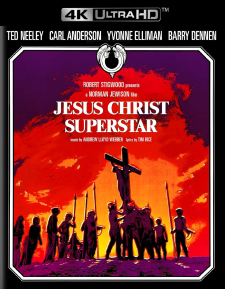
Jesus Christ Superstar (4K UHD Review)
Director
Norman JewisonRelease Date(s)
1973 (September 29, 2026)Studio(s)
Universal Pictures (Kino Lorber Studio Classics)- Film/Program Grade: A-
- Video Grade: A-
- Audio Grade: A-
- Extras Grade: B+

Review
On August 1, 2025, Cynthia Erivo had her first performance in the title role of Jesus Christ Superstar at a three-night engagement in the Hollywood Bowl, and she ended up blowing the roof off the joint (metaphorically speaking). Minds were also blown, and after cell phone videos of her singing Gethsemane were uploaded to YouTube, they quickly went viral, blowing even more minds far and wide. Well, aside from a few closed minds, anyway. There was also an immediate backlash from certain quarters of the internet, with words like “demonic” being thrown her way. Most of the complaints came down to three interconnected factors: first of all, she’s a woman; second, she’s black; and third, she openly identifies as queer. That was three bridges too far for some of the gatekeepers out there, so they made videos of their own denouncing her for playing the role.
That’s sad but not particularly surprising, but the irony lay in what they didn’t criticize: the fact that she was playing a version of Jesus that emphasizes his humanity and omits the resurrection while, you know, singing anachronistic rock & roll songs. So, while the pushback demonstrated that some things never change, others clearly have, and the goalposts have indeed shifted. The fact that Jesus Christ Superstar is a rock opera that humanizes a foundational religious figure doesn’t seem to be a problem anymore, even from defenders of that religion. Of course, the reality is that it never should have been an issue in the first place, since we’re talking about a fictional character here—and no, I’m not saying that Jesus himself is fictional, but rather that the Jesus of Jesus Christ Superstar is pure fiction straight out of the imaginations of composer Andrew Lloyd Webber and lyricist Tim Rice.
To be fair to Jesus Christ Superstar, that’s true of any retelling of the life of Christ, in any form in any medium. Films and miniseries like The Greatest Story Ever Told, Jesus of Nazareth, The Passion of the Christ, and The Chosen are all purely fictional works regardless of their relative merits—they’re not documentaries, but rather works of the imagination that make their own creative choices. And frankly, none of them are as faithful to the Gospel accounts as Pier Paolo Pasolini’s superb The Gospel According to St. Matthew, which has sometimes gotten the side eye from gatekeepers due to the fact that Pasolini was an atheist, Marxist, and a homosexual (in terms of pushback, some things never change). So, since they’re all fictionalized retellings anyway, why not reimagine the inherently countercultural nature of Jesus Christ as a rock & roll counterculture figure for the modern age?
That’s exactly what Webber and Rice did with their 1970 concept album Jesus Christ Superstar, although the fact that it began life as an album is proof that controversy has dogged their rock opera since its inception. They always intended it to be a stage musical but couldn’t get any backing, so they tested the waters with the album first. And while it didn’t make much of a splash at the time, it did lead to a Broadway production the following year, and a film deal shortly thereafter. For the album, Deep Purple’s Ian Gillian sang the part of Jesus, with Murray Head as Judas, Yvonne Elliman as Mary Magdalene, Victor Brox as Caiaphas, and Barry Dennen as Pontius Pilate. By the time that it moved to Broadway, Jeff Fenholt was Jesus, with Ben Vereen as Judas and Bob Bingham as Caiaphas, although Elliman and Dennan did make the leap to the stage. The latter three would survive the transition to Universal’s film production, but fatefully, theatrical understudies Ted Neeley and Carl Anderson would take over as Jesus and Judas, making the roles indelibly their own. Many other performers have played Jesus and Judas over the half century since Jesus Christ Superstar made its film debut in 1973, but there will always be only one Ted Neeley and Carl Anderson.
Setting aside their vocal performances for a moment, the biggest reason why is that they perfectly personified the Jesus and Judas as conceived by Webber and Rice. The reality is that the composer and lyricist actively courted controversy with Jesus Christ Superstar in the way that they chose to handle these two characters. While they never openly denied the Trinitarian conception of Jesus as being not just as the Son of God, but also as God the Son, their version of Jesus is very, very human indeed, calling into question whether or not all this talk of God is true. But contrary to what Christian dogma may hold, that’s not exactly a novel concept since the doctrine of the Trinity wasn’t fully established until centuries after Jesus walked the earth. What was relatively novel was that Weber and Rice chose to invert the core conflict by telling the story of Jesus from the point of view of Judas, with the latter serving as a disillusioned antihero. And while some will doubtless disagree, legions of fans of Jesus Christ Superstar have long held that no one has better embodied the humanity of Jesus and the melancholy of Judas better than Neeley and Anderson.
It certainly didn’t hurt that Universal opted to hire Norman Jewison to write and direct the film, hot off his recent success with Fiddler on the Roof. Jewison and co-screenwriter Melvyn Bragg made the canny decision to emphasize the theatricality of the proceedings by adding a framing device where the cast travel by bus to the Israeli and start to prep the production, unloading all of the costumes and props (including the cross). This introduction serves as a reminder that even though the play has been opened up using authentic locations, it’s still very much a staged drama, not a documentary. Yet the lines quickly start to blur: Barry Dennen is already starting to act aloof, and Josh Mostel lounges imperiously on the roof of the bus, foreshadowing his pomposity as Herod. Most significantly, Carl Anderson is already being treated as an outsider, while Neeley is openly feted by the rest of the group (well, aside from Dennen, Mostel, Brox, and the actors playing their supporters, anyway). So, Anderson wanders off by himself into the desert, very much in character as Judas, and Jesus Christ Superstar proper begins with his unforgettable performance of Heaven on Their Minds.
Jesus Christ Superstar makes other alterations to the source material as well, changing a few of the lyrics and adding or subtracting other material (including the addition of one new song not heard on either the album or the Broadway production). But Jewison still used the album as the template for his film version, not just drawing inspiration from it, but also using much of the original backing tracks behind the new vocal performances. André Previn was brought in to aid with the new orchestrations and conduct the actual orchestra, lending an undeniable gloss to the production, but the base material was still very much derived from the album. As a result, Jesus Christ Superstar the film engendered plenty of controversy of its own due to the way that Webber, Rice, Bragg, and Jewison treated the characters of Jesus and Judas. It also drew accusations of antisemitism given that they followed the Biblical narrative of the Jews bearing responsibility for Pilate’s choice to crucify Jesus. So, some of the controversy was over how they strayed from the source material (or at least from traditional interpretations of it, anyway), while some was because they followed it too closely. You can’t win but for trying sometimes.
And yet Jesus Christ Superstar abides, having weathered any and all of the opposition over the decades to go on to be considered a universally beloved classic, both on stage and on film. Even the mixed reviews that the film received during its original release have faded with time. That’s a testament to Jewison, Neeley, Anderson, and the rest of the cast & crew, but it’s also a testament to the power of Webber and Rice’s source material. However much that Jesus Christ Superstar reimagines the Biblical account, however anachronistic the music may be, it still speaks to universal human truths that have resonated with generations of audiences all over the globe. And that’s why Cynthia Erivo’s performance in 2025 made such an impression: she tapped deeply into the well of anguish felt by Jesus as he struggles to accept that his mission is to die, no less than Neeley had done five decades earlier. That’s a universal truth that transcends gender, racial, and yes, even sexual lines, and that’s why Jesus Christ Superstar will continue to abide regardless of any continuing pushback from a vanishingly small contingent of detractors. Maybe they’d be better off paying more attention to the Mary Magdalene of Jesus Christ Superstar than to Jesus or Judas:
“Try not to get worried, try not to turn on to
Problems that upset you, oh.
Don’t you know
Everything’s alright, yes, everything’s fine.”
Cinematographer Douglas Slocombe (who replaced an injured Alex Thompson after a week of shooting) shot Jesus Christ Superstar on 35mm film using Todd-AO anamorphic lenses—Todd-AO 35 format, not to be confused with the original 65mm version of Todd-AO. Jesus Christ Superstar was indeed released with 70mm prints, but those were blown up from 35mm, with 35mm prints framed at 2.39:1 and 70mm blowups at full-frame 2.20:1 instead. This version is based on a 4K scan of the original 35mm camera negative, digitally remastered and graded for High Dynamic Range in Dolby Vision and HDR10. It’s a gorgeous 4K presentation.
Everything is clean aside from a few fleeting single-frame blemishes that aren’t really visible in motion, and the grain is generally handled quite well, aside from a few of the usual Kino Lorber encoding artifacts like swirling patterns visible in the skies (although again, they’re only really noticeable if you go looking for them). The contrast range is excellent, with deep blacks during the finale and gleaming specular highlights like the sun glinting off the silver helmets of Pilate’s soldiers. The color reproduction is excellent as well, from Pilate’s purples to Mary’s oranges and Judas’ amazing multicolored jumpsuit. But the best news is that it looks like Jesus Christ Superstar was originally printed A/B roll, because with perhaps one or two exceptions, most of the dissolves and overlays have been recreated digitally here from the OCN, not from internegative optical footage cut back into it, so there aren’t any generational losses. It’s an across-the-board upgrade from the old 1080p Blu-ray master.
Audio is offered in three different flavors: a new 2026 5.1 DTS-HD Master Audio mix by engineer Brian Kehew, a 2.0 DTS-HD Master Audio version of the same mix (which doesn’t seem to have encoded surrounds), and the original mix in 2.0 DTS-HD Master Audio—although calling it “original” is dubious at best. Jesus Christ Superstar was released theatrically in 6-track mag on 70mm prints, 4-track mag on a handful of 35mm prints, and optical mono for the wide release 35mm version, so there never was a straight 2.0 stereo mix with or without encoded surrounds (and optical Dolby Stereo wasn’t yet a thing in 1973 anyway). There has been a 2.0 stereo mix with encoded surrounds that was included on Universal’s previous Blu-ray releases, and presumably this “original” mix is the same track, although I didn’t end up comparing the two. That’s because I spent all of my time comparing the new 2026 mixes with the original 2.0 version here instead, and the results were interesting to say the least.
Comparisons can be a little challenging since the various tracks aren’t level-matched, and the new mixes are definitely post “loudness wars,” so the dynamics have been somewhat compressed and loudness can be perceived as greater fidelity. But even after compensating for that, there’s no denying that the new mixes sound more potent than the old one, with greater separation and clarity, more crunch to the guitars, and plenty of punch to the mix as a whole. There’s a significantly wider stereo spread, and in 5.1, many of the instruments have been pulled farther forward into the soundstage, with the orchestra in particular going deeper into the surrounds—enough so that it threatens to overwhelm the vocals at times. Now, the caveat there is that there doesn’t appear to be a center channel in the 5.1 version, but the overall balance doesn’t seem significantly different in the 2.0, so that may be intentional. In any event, you can clearly hear instrumental details now that were a bit muddy in the old mix.
So, improvements in breadth and depth are a little offset by questionable decisions regarding the overall balance, but that said, after switching back and forth repeatedly (and adjusting the volume every time), the positives of the new mix clearly outweigh the negatives for me. Compressed dynamics or not, unbalanced vocals or not, it still sounds much brighter, clearer and fresher than the old mix. It brings the music from Jesus Christ Superstar to vibrant life for modern audiences. But as always, audition both and decide for yourself.
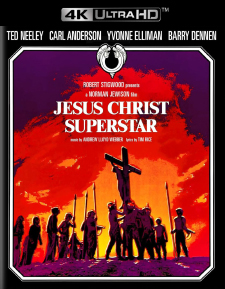
The Kino Lorber Studio Classics 4K Ultra HD release of Jesus Christ Superstar is a two-disc set that includes a Blu-ray with a 1080p copy of the film, as well as a slipcover that duplicates the theatrical poster artwork on the insert. The following extras are included:
DISC ONE: UHD
- Commentary by Norman Jewison and Ted Neeley
- Commentary by Gary Gerani
- Commentary by Simon Abrams
DISC TWO: BD
- Commentary by Norman Jewison and Ted Neeley
- Commentary by Gary Gerani
- Commentary by Simon Abrams
- Interview with Tim Rice (SD – 14:32)
- Jesus Christ Superstar Trailer (HD – 1:09)
- The Russians are Coming, The Russians are Coming Trailer (SD – 4:30)
- The Pirates of Penzance Trailer (HD – 2;27)
- Thoroughly Modern Millie Trailer (HD – 2:39)
- King Creole Trailer (HD – 2:33)
- Flower Drum Song Trailer (SD – 2:46)
- Xanadu Trailer (HD – 2:05)
- The Art of Love Trailer (HD – 2:47)
Kino has added two new extras for this release. The first is a commentary by screenwriter and author Gary Gerani, who admits up front that while he’s going to try to be objective, Jesus Christ Superstar is one of his top-ten favorite films of all time. In cinematic terms, telling the story of Jesus as a rock opera is pure high concept, or as he notes that Norman Jewison and Ted Neeley said in their own commentary, it’s essentially a feature-length music video. Gerani does provide some background information like biographical details about the cast and various tidbits about the production, but he spends more time analyzing the stories, characters, and songs. But as a die-hard fan, he does go deep background into the conception and writing of the original album, including biographical information about Webber and Rice. He also discusses the staging of the various musical numbers, including details like the star filter that Douglas Slocombe used for the final Superstar number.
The second new extra is a commentary by critic and author Simon Abrams. He’s a fast talker who starts by racing through details about the character and casting of Judas before a genuinely off-putting moment where he stops to say that he will be slowing down eventually, so if you worried that he won’t, that “seems a bit presumptuous on your part, frankly.” He also admits that he’s butchering some of the names, but says to be grateful that he doesn’t have to pronounce them more often. Pro commentator tip: never place the onus of your own failings on the listener. I’ll freely admit that I lost interest in the rest of your track as a result, but he does get around to discussing the album, the film, the characters, the cast, and the crew, as well as some of the controversy that has dogged the film like accusations of antisemitism. Your mileage may vary with Abrams, but my recommendation is to reward him for his arrogance by skipping him.
The rest of the extras are archival, starting with a commentary featuring Norman Jewison and Ted Neeley that was originally recorded for the 2004 DVD from Universal, three decades after they originally made the film. They reminisce about the cast and tell stories about the making of the film, including plenty of personal details like the fact that the bus seen in the prologue was actually Ted Neeley’s tour bus. Carl Anderson died shortly before they recorded the track, so much of it ends up serving as a tribute to him. And despite having played the role more than a thousand times, Neeley still gets emotional during his crucifixion scene. But Jewison does offer some technical details (and a few practical ones as well, like having to clean guano out of the cave location). He also points out that the shepherd crossing the frame under the cross at the end of the film was a complete accident—the shepherd just appeared out of nowhere.
Finally, there’s an Interview with Tim Rice from the same DVD where he describes how he was fascinated by the idea of telling the story of Jesus from Judas’ point of view, long before he even met Andrew Lloyd Webber. He also explains how the concept album was used to sell the film as a theatrical show; their approach to rock opera; the controversy surrounding the way that they told the story and accusations of antisemitism; the multiracial nature of the casting; his own limited involvement with the film (including why his ideas weren’t used); and the legacy of Jesus Christ Superstar.
Well, one out of two ain’t bad in terms of the new extras, and the archival Jewison/Neeley commentary is always a welcome inclusion. It’s still not exactly a stacked special edition for Jesus Christ Superstar, but the quality of the 4K presentation and Brian Kehew’s new audio mix is the real draw here, and as a result, Kino Lorber’s 4K Ultra HD release of Jesus Christ Superstar is highly recommended.
- Stephen Bjork
(You can follow Stephen on social media at these links: Twitter, Facebook, BlueSky, and Letterboxd).