
Legend of the Sacred Stone (Blu-ray Review)
- Review Date: Jun 15, 2026
- Format: Blu-ray Disc
-


Director
Huang Chiang-huaRelease Date(s)
2000 (April 25, 2026)Studio(s)
Bandai Visual Company/PiLi International Multimedia (Deaf Crocodile Films)- Film/Program Grade: B
- Video Grade: B
- Audio Grade: B+
- Extras Grade: B+

Review
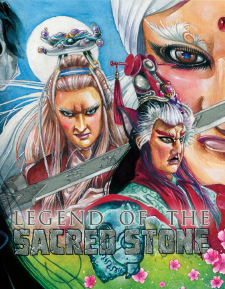
In the early 2000s, a talented group of artists set out to make a feature-length film with all of the characters portrayed by puppets, moving them out of the realm of television and onto the big screen, as a loving tribute to the traditions that had gone before them.
...and four years later, Trey Parker and Matt Stone made Team America: World Police.
While Parker and Stone’s homage to Gerry and Sylvia Anderson’s “Supermarionation” puppet shows like Thunderbirds received a great deal of attention at the time, it wasn’t really groundbreaking, since the Andersons themselves had already released multiple feature films like Thunderbirds Are Go and Thunderbird 6 back in the Sixties. But more to the point, it wasn’t the first attempt to revive puppet films in the 2000s, either. That honor goes to the Pili International Multimedia production Legend of the Sacred Stone (aka Sheng shi chuan shuo), which was itself a spinoff from their long-running Pili television series. Yet while it’s much less familiar to western audiences, Legend of the Sacred Stone is no less of a landmark in the history of puppet filmmaking.
Granted, for the pedantic at heart, the characters in Team America and Thunderbirds are technically marionettes while Legend of the Sacred Stone and Pili both employ glove puppetry (although for many viewers, that’s a distinction without much of a difference). Yet there’s still an interesting point of comparison between the two. Yes, Parker and Stone were making an homage to Supermarionation, but it was in service of their own broader satirical intentions—in some ways, Team America was just South Park with puppets instead of cardboard cutouts. Legend of the Sacred Stone is also an homage, but not to the art of budaixi puppetry itself—in that respect, it’s just a continuation of the Pili television series. No, it’s actually an homage to the wuxia movies that had inspired the series, taking full advantage of the film medium to explore the tropes of the genre in a way that the shot-on-video television series could only imitate but never fully replicate.
And good lord, did Pili director Chris Huang ever pull out all the stops for Legend of the Sacred Stone. Crash zooms, whip pans, rack focusing, step-printed slow motion, and acrobatic wire work (yes, since these are puppets not marionettes, it really is wire work)—you name it, Legend of the Sacred Stone has it all. There are also abundant closeups of fancy footwork, something that you might not expect to see in a puppet film. Rather than staging everything from a distance in full tableaus, Huang shot plenty of medium shots and closeups, with rapid cutting between the angles—there are more shots in the first ten minutes of Legend of the Sacred Stone than in all of Team America combined. It gives everything an astonishing visual energy, and yet despite the rapid-fire editing, the action remains comprehensible thanks to the fact that Huang and his crew put genuine thought into everything that they did.
While Legend of the Sacred Stone does employ some relatively low-fi digital effects, they’re entirely in keeping with the spirit of the optical visual effects in classic wuxia and xianxia films. In fact, if you squint at the screen, it’s easy to forget the digital effects and the puppets and think that you’re watching a “real” martial arts film from the likes of Shaw Brothers Studio, Tsui Hark, or any of the other classic practitioners of the art. And that’s a good thing in this case, because the lore behind the Pili series is almost impenetrably dense, so familiarity works in its favor. Legend of the Sacred Stone opens with the following narration:
“400 years ago, Mo Kuei threatened the entire Wulin. The great sage Su Huan-Jen, in his attempt to eliminate evil, summoned the warriors from the Three Clans. They tried to defeat Mo Kuei while he was on the top of Sky Ridge and absorbing the spiritual Qi.”
That sets the stage for an epic battle between Mo Kuei and the warriors from the clan, but the hitch is that the entire battle is just setting the stage for the rest of the story, which is far too complex to summarize here. Suffice it to say that it’s a classic wuxia and/or xianxia tale of honor, loyalty, betrayal, magical artifacts, and romance, with much of it revolving around the longtime Pili character Su Huan-Jen. Yet in the best tradition of budaixi, the narration and all of the characters were voiced by Chris Huang’s brother Victor, who continued to handle voice duties for Pili and its spinoffs until his death in 2022.
For anyone who is unfamiliar with the Pili universe, keeping track of the characters and the story can be a bit challenging, but if you think of it as traditional wuxia that just happens to feature puppet characters, it all becomes easier to follow. It utilizes so many familiar tropes of the genre that it should be comprehensible enough if you just relax and go with the flow. If there’s just one flaw with Legend of the Sacred Stone, it’s that like most puppet films, it can wear out its welcome before it’s over (this kind of thing just seems to work better in small doses like a television series). But if you’ve never experienced the amazing world of budaixi puppetry, Legend of the Sacred Stone still works as a fine introduction to the art, and a truly impressive homage to the world of wuxia as well.
Cinematographer Meng-Yu Tsai appears to have shot Legend of the Sacred Stone on 35mm film, but details are otherwise scant. There’s also little to no information available regarding this 1.85:1-framed 1080p master, although the commentary track does reference a 2022 restoration screening, so it appears to be a relatively recent digital remastering. 35mm or not, there’s a slight softness to the image that looks like the results of generational losses, so the negative may not have been available, and this was likely scanned from the interpositive or internegative instead. The contrast and colors are also somewhat muted, although that seems accurate enough. The digital effects were likely still composited optically, and even if they weren’t, they would have suffered from the effects of relatively low-resolution digital composites, so they’re even softer than the surrounding material. But everything looks clean, with little to no visible damage, and the grain is largely intact (although again, it doesn’t look like sharp grain from a negative scan). But any way that you slice it, this is a huge upgrade from the previous overseas DVDs.
Note that this is the 100-minute theatrical version, although there was supposedly a 129-minute extended version prepared for the Taiwanese DVD. But that’s where things get really, really murky. The back of the Deltamac DVD does indeed list the running time as 129 minutes, but it’s telling that there’s a 29-minute audio/visual press kit included that’s not listed on the packaging, and the run time of the film itself plus that extra adds up exactly to 129 minutes. I found at least one reference elsewhere to a supposed 120-minute director’s cut that was available on streaming, but no hard evidence that it actually exists. We’ll update this if I can find any more concrete information, but it’s worth remembering that yes, this kind of thing is better in shorter doses, so 100 minutes seems long enough.
Audio is offered in Chinese 2.0 mono DTS-HD Master Audio, with removable English subtitles. Despite the lack of any kind of stereo spread, this is still a modern mono mix, with greater dynamics and deeper bass than many older films can offer. Victor Huang’s various voices (including that of the only major female character, Jian Ru-bing) are reproduced perfectly, while the score and songs from Wu Bai, China Blue, and the Shanghai Symphony Orchestra has plenty of depth (if no actual breadth).
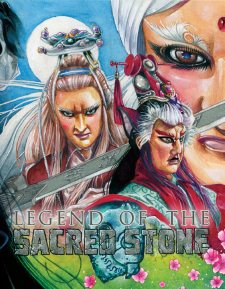
The Deaf Crocodile Deluxe Limited Edition Blu-ray release of Legend of the Sacred Stone includes a 60-page booklet featuring essays by Rupert Bottenberg and Walter Chaw. Everything comes housed in a rigid slipcase with a J-card slipcover, with new artwork designed by Richard Cox. The set is limited to 1,500 units, and Deaf Crocodile has recently posted on social media that it’s down to the last few copies, so act fast if you want the full package (although a standard version is now up for pre-order). The following extras are included:
- Commentary by Ben Wolf Page
- Puppets, Wuxia, and Spirituality: The Lore and Inspirations Behind Legend of the Sacred Stone (HD – 17:02)
- Character Spotlight: Su Huan-Jen (Upscaled SD – 5:00)
- Interview with Chris Huang and PILI Puppeteering Team (HD – 41:47)
- Original Trailer #1 (HD – 1:53)
- Original Trailer #2 (HD – 1:30)
- Deluxe Edition Artwork Creation (HD – :44)
- Deaf Crocodile Trailers:
- The Pied Piper (HD – 2:05)
- Jiri Barta Shorts (HD – 1:29)
- Hoffmaniada (HD – 1:24)
- Song of the Miraculous Hind (HD – 1:30)
- Dead Mountaineer’s Hotel (HD – 1:35)
The commentary features Ben Wolf Page, puppeteer and associate editor of The Puppetry Journal for the Puppeteers of America organization, and needless to say, he knows his stuff (although he apologizes for pronunciations of some of the Chinese names). Naturally, he delves into the techniques of budaixi, contrasting it with other Asian puppetry traditions like bunraku, but he explores the cinematography, editing, and locations of Legend of the Sacred Stone. He elaborates on that by diving into the complicated lore of the Pili series and how it relates to the story in the film (this is one case where someone describing the plot isn’t necessarily a bad thing). He also relates all of that to traditional wuxia tropes and Chinese myth in general. While he admits that puppet films can be difficult to watch in one sitting, in his opinion, Legend of the Sacred Stone is a kickass movie.
Puppets, Wuxia, and Spirituality: The Lore and Inspirations Behind Legend of the Sacred Stone is a visual essay by YouTuber Evan Chester. He provides a much broader overview of the wuxia genre and the way that it has evolved through different media and especially in the world of cinema. From there, he examines the Pili series and how it spawned the tale told in Legend of the Sacred Stone, tying everything back to his look at wuxia by pointing out the tropes that it uses.
Of course, Deaf Crocodile is also including another online interview hosted by Dennis Bartok, featuring Chris Huang joined by two members of the Pili puppetry crew, senior puppeteer Wu Ji-Fu and deputy drama director Lin Kuei-Hsia. (They’re aided by a translator who has been mostly edited out of the interview, with their responses being subtitled in English instead.) Since the puppeteers needed to get back to the production stages and had to leave the interview early, Bartok starts with them first, asking them technical questions related to their work on the film. After that, he turns to Huang and broadens the scope to include his family history with budaixi; his own work as a puppeteer; becoming a director; the creation of the Pili series; how the film fits into the mythology and characters from the series; having to create all-new puppets and sets for the film; and the way that advancing technology has impacted their work.
Finally, in addition to a collection of trailers for other Deaf Crocodile titles, there are a couple of other pieces of miscellany. The Deluxe Edition Artwork Creation is a brief montage showing the evolution of Richard Cox’s artwork, while Character Spotlight: Su Huan-Jen is a montage that shows how the character of Su Huan-Jen has evolved over the decades that the series has been in production.
While Legend of the Sacred Stone has been completely MIA in North America, at least officially, there are a few extras missing from previous overseas releases. The Taiwanese DVD offered the audio/visual press kit, while the 2024 Region B Blu-ray from Spectrum in France had a lecture by Paul Gaussem; the Inside Studio Pili documentary; an interview with Chris Huang; and two episodes of the Thunderbolt TV series. But Deaf Crocodile offers a great slate of extras of their own with their usual beautiful packaging. Plus, it’s Region A friendly. Legend of the Sacred Stone won’t be for everyone, but if you’re a fan of either puppetry or wuxia films in general, it’s a fantastic set that’s well-worth picking up—but act fast if you want the full meal deal! Highly recommended.
- Stephen Bjork
(You can follow Stephen on social media at these links: Twitter, Facebook, BlueSky, and Letterboxd).